
Superdiversity and the neoliberal conspiracy

12743868_10154614952503327_7794998341329344111_n

Jan Blommaert 

The problem

In a stimulating paper published in 2014, Ryuko Kubota expresses her concern about what she calls the “multi/plural turn” in the study of multilingualism (within Applied Linguistics, note), and cautions scholars “celebrating”  multi-, plural- or metrolingualism for entering a high-risk zone: that of “complicity” with neoliberalism.

However, as this ‘turn’ grows in popularity, it seems as though its critical impetus has faded and its knowledge is becoming another canon—a canon which is integrated into a neoliberal capitalist academic culture of incessant knowledge production and competition for economic and symbolic capital, and neoliberal multiculturalism that celebrates individual cosmopolitanism and plurilingualism for socioeconomic mobility. (Kubota 2014: 2)

Kubota appears to be highly skeptical of work addressing contemporary forms of multilingualism and multiliteracies from the perspective of complexity. Such work, she suggests without much elaborate argument (or definition), is “postmodern”, and postmodernity, ostensibly, is to be approached with extreme caution, for it appears to render a critique of fundamental (“real-world”) inequalities and hegemonic pressure very difficult, if not impossible:

Although metrolingualism problematizes hybridity as superficial celebration, it is still grounded in the postmodern affirmation of multiplicity and fluidity, which keeps it from critiquing how inequality is often solidified or intensified within multiplicity and fluidity. (Kubota 2014: 4)

And this, then, risks enlarging and deepening the gulf between “theory and practice” in Applied Linguistics. “Postmodern” approaches are “theoretical”, they “celebrate” hybridity, fluidity, flexibility in language-and-identity work, and thus overlook the harsh realities of, for instance, the struggles of indigenous people to retain their endangered native languages – one case of “real world” hegemonic pressure – and the global dominance of English – another such instance.

Since I share many of Kubota’s “real world” concerns (she favorably cites some of my work on African asylum applicants), I intend to assist her in this mission. I shall do this from the specific viewpoint of sociolinguistic superdiversity (henceforth SSD; cf. Arnaut et al. 2016; Blommaert 2013).[1] The reason for that is that much of the work on SSD might be vulnerable to Kubota’s critique since such work would pay attention to complex forms of spoken and written code-mixing called “languaging”, and would emphasize mobility, flexibility, instability and fragmentation in most of its outcomes. I will structure my attempt around three theoretical assumptions in Kubota’s argument, which invite a critical scrutiny precisely from the viewpoint of SSD. Kubota, we shall see, opts for traditional, static and hence anachronistic versions of such assumptions. When reformulated from an SSD perspective, some of her fears can, one hopes, be alleviated. The first point conditions (and will clarify) the two subsequent ones.

Note, for clarity’s sake, that I do not necessarily endorse all the work currently being done under the label of sociolinguistic superdiversity (nor, more broadly, that done within the “multi/plural” trend identified by Kubota – because, yes, there is work that foolishly presents new forms of diversity as an unqualified good news show). But I can speak for myself and have the luxury of drawing on the efforts we collectively undertake within the INCOLAS framework.[2] And it is good to remind readers of what it is we do in such work. We describe contemporary sociolinguistic phenomena and patterns, in an attempt to arrive at an accurate and realistic ontology for contemporary sociolinguistic analysis – what are the objects of analysis exactly? And from such descriptions, we try to distill the theoretical generalizations that they afford. To the extent that we produce “theory”, therefore, our theory is a descriptive theory, not a normative one or a predictive one. And we do all of this (a) drawing on a broad range of inspiring work in macro-sociolinguistics, interactional sociolinguistics, linguistic anthropology, linguistic ethnography, discourse analysis, literacy and multimodality studies, new media studies, sociology, critical theory and cultural studies; and (b) with a very strong preference for “applied” sites of research in which the big issues of contemporary social struggle are played: education, immigration, the labor market, popular (online) culture and information economies, policing and surveillance. The essays in Arnaut et al (2016) can serve as a sample of our approach, the series of working papers we edit offer a wider panorama.

Ideology

The concept of ideology utilized by Kubota in her paper is the “political ideology” one – where “ideology” stands for things such as neoliberalism, capitalism, Marxism and so forth and is closely connected with institutions and centers of power.[3] Thus, when she points towards the “ideological” effects of certain kinds of academic work, such effects could be “complicity with neoliberalism”, for instance. As in “the problematic ideological overlap between the multi/plural turn and neoliberal multiculturalism” (Kubota 2014: 2). She adopts, one could say, the version of “ideology” widespread in Critical Discourse Analysis: something that does not operate in language-in-society, but on language-in-society, as an external force operating hierarchically through institutional power.

She seems to find little value in (or at least: has not used) the work on language ideologies – perhaps the most momentous theoretical intervention in the study of language and society of the past decades (e.g. Silverstein & Urban 1996; Kroskrity et al. 1998; Kroskrity 2000; Agha 2007). Kubota does mention the “standard language ideology”, but not in a language-ideological analytical sense: this phrase refers to a top-down institutional hegemony, to an institutionally enforced normative and prescriptive “regime of language” in other words. This is a great pity, for one of the crucial effects of language ideology research is that it has shaped a new sociolinguistic ontology. “Language” – that clumsy modernist notion – can now be seen as a “laminated” object consisting of practices joined, organized and structured by beliefs about practices – pragmatics and metapragmatics always operate in conjunction whenever people produce and exchange bits of “language”. The term “standard language ideology”, in language-ideological terms, would stand for the socially ratified belief that specific forms of language are “standard” forms and thus better than other “nonstandard” forms (cf. Silverstein 1996), not for the prescriptive institutional normativity imposed, for instance, on school systems, public administrations or law courts. Such language ideologies – take the “standard language ideology”, exist and persist with a degree of detachment from observable sociolinguistic practices. A strictly enforced “standard language ideology” in schools, for instance, may be “adhered to” (and even vigorously defended) by teachers who, in actual fact, produce tremendous amounts of  “substandard” speech in class.

The laminated object of language ideologies research enables us to see broad, and socio-politically highly significant, gaps between observable language behavior on the one hand, and beliefs about such behavior on the other hand. People very often act in outright contradiction with firmly held beliefs about such actions. This does not lead language ideology scholars to dismiss such language-ideological beliefs as “false consciousness”, i.e. wrong and therefore irrelevant beliefs: it is precisely the tension between such beliefs and the characteristics and patterns of actual activities that leads such scholarship to robust, critical and innovative statements on the relationships between language and social structure (Agha 2007).

Kubota writes, referring to some of my work:

Contrary to the postmodern sociolinguistic idea that language is no longer fixed at a certain location (…), claiming to belong to ancestral land constitutes important means for language preservation or revitalization and for resistance in indigenous communities. (Kubota 2014: 9)

In view of what was said above, I see no contradiction. I see two different objects: one, an empirically observable detachment of actually-used-language from locality (hard to deny when one considers, for instance, the global spread of different forms of “English” and new modes of online diasporic life); and another one referring to strongly held beliefs denying such forms of mobility. Both require attention and disciplined inquiry, for precisely the capacity for delocalization may contribute to successful struggles for “local” language revitalization. The fact that people are emphatic in claiming a unique local authenticity for their language does not, in no way, predict their actual patterns of language usage. In fact, nowadays such powerful claims are often made in English, and on the internet rather than in the village.

Failing to observe such distinctions, and take them seriously, obscures both the actual ways in which power operates, and the precise loci of such power. As for the former: a strongly stressed monoglot regime can, in actual fact, prove extraordinarily lenient and flexible when observed in practice (we very often see the curious balance between “orthodoxy” and “orthopraxy”, described by James Scott, with various forms of “hidden transcripts” emerging – Rampton 2006). As for the latter, I know that there is a strong tendency to see power regimes as “total”; but I know that in actual fact, even very “total” ones contain cracks and gaps – something we should have learned from Bakhtin and Voloshinov. This is not to minimize power, on the contrary: it is taking it absolutely serious by being absolutely precise and factual about it. No social cause is served by shoddy work, Dell Hymes famously said. I couldn’t agree more.

The dated and altogether extremely partial conceptualization of ideology by Kubota makes her overlook such crucial features of contemporary sociolinguistic economies, and closes lines of creative thinking about solutions for sociolinguistic inequality. One such line, we shall see, has to do with how we conceptualize “language”. To this I can presently turn.

Language

I have read – but forgot the locus – that I “deny the existence of language”. This would be a pretty disconcerting allegation for a scholar of language, were it not that I have a reasonable and reasoned answer to that. I do not deny or reject anything, I refute, usually on generously evidenced grounds, a particular conceptualization of language as a unified, countable and closed object. The “modernist” version of it, in short, that characterized the synchronicity of structuralism in its Lévi-Straussian varieties.[4] This modernist version of “language” is entirely inadequate for describing sociolinguistic phenomena and patterns as currently practiced by subjects in very large parts of the world. To my repeated surprise, I have seen prominent scholars in Applied Linguistics subscribing to precisely such modernist versions, particularly when they discuss the areas where such a version is least applicable: endangered languages and the global dominance of English. Kubota is one of them, even if she is at pains to argue the opposite.

In order to understand the problem, we must outline the SDD position – again largely influenced by the language ideologies insights discussed above. First, I must repeat what I said above: we must distinguish between two different ways of using the term “language”. One is Language with a capital L – the named objects of lay discourse such as “English”, “Chinese” or “Zulu” – which is real as an ideological artifact because people believe it exists. It exists as a belief system and has often been given an institutionalized reality. The second is language as observable social action – the specific forms people effectively use in communicative practice. These forms are infused with language-ideological beliefs, but, as we saw earlier, they can contradict such beliefs, and such contradictions are not necessarily noticed. People in practice use a wide variety of resources, some of which are conventionally (i.e. indexically) attributed to some “Language” (e.g. English) even if the connection between such resources and the codified, standardized form of that “Language” is highly questionable. To which “Language”, for instance, must we assign globally used emoticons?

Two, this means that when we focus on the second “language” – the actual practices – we notice that established labels – such as “English” etc. – become a burden. For what we see in actual communicative practices is that people produce ordered sets of resources (attributed, sometimes and not necessarily, to some Language) governed by specific social norms specifying “orderly” social behavior in a specific social space. Different resources will be used, for instance, by the same person when addressing his mother than when addressing his school teacher. And the highly specific and situated (but structured!) nature of such practices enables us to understand why the same resources can have an entirely different value and effect in different situations – take a Jamaican accent in English, negatively valued in the classroom, neutrally in the ethnically heterogeneous peer-group, and positively in the after-school Reggae club (Rampton 1995). We see, thus, registers in actions, not Languages (cf. Silverstein 2003; Agha 2007), and such registers operate chronotopically, in the sense that we see them being put to use in highly specific timespace configurations, with specific identity-and-meaning effects in each specific chronotope. Shifts from one chronotope into another involve massive reordering of norms, resources and effects – Goffman’s “footing shifts” on steroids, one could say.

Registers, as a descriptive and analytical concept of immense ethnographic accuracy, allow us to explain otherwise contradictory phenomena as structured, in the sense that different phenomena must be situated in different spheres of social life. Above, I quoted Kubota’s pointing towards an alleged contradiction related to my work. In her text, she elaborates that tension as follows:

Indeed, it is difficult to negotiate two opposing poles: political efforts to seek collective rights to identity and attempts to support indigenous youths who negotiate their hybrid identity. (…) Additionally, who proposes either hybridity or authentication as a goal to be sought on what grounds? (Kubota 2014: 10)

We can only speak of “opposing poles”  when the totality of social life is imagined as one straight line, as a singular and homogeneous thing in which just one set of norms dominates. There is no opposition, of course, when one sees both options as belonging to entirely different spheres of social life – one a tightly organized and scripted community struggle for identity recognition often based on “invented traditions” of purity, heritage and authenticity; the other a small peer group encounter in which youngsters discuss hiphop, for instance. No choice is required – there is no “either-or” scheme – for what happens is that the same youngsters participate in the first activity between 10 and 12 in the morning, after which they leave the larger group and congregate around a sound system in some friend’s room. Bakhtinian heteroglossia with an interactional-sociolinguistic twist, one could say. Ethnographic accuracy (and sociological realism, I’d add here) solves what looks like an intricate political puzzle here.

Observe, at this point, three massively important things.

  • One: I fail to see how such analyses could “celebrate [neoliberal] individualism”. I will elaborate this point below, but we can already see that whatever is observed here is entirely social and can only be understood as such. Referring to my earlier point about the precise loci of power: we will begin to understand where power actually operates oppressively, and where it can be liberating and enabling, when we accept that social life does not proceed along one simple set of rules and norms, but demands an awareness of several sets of norms, to be played out in highly diverse social fields, some of which will be institutionally highly policed (think of the classroom above), while others obey very different power actors (think of the Reggae club). Power is a polycentric social fact.
  • Two, this also counts for the inevitable notion of “repertoire” – too often dismissed as the hallmark of individualism whenever it’s being used. Repertoires are always strictly unique, for they bespeak an individual’s life trajectory. But – see above – since such trajectories, whenever they involve communication are by definition social, we shall see that repertoires are structured in the sense of Bourdieu: repertoires reflect the specific social history lived by individuals, and both the “social” and the “historical” need to be taken into account. Whatever is in someone’s repertoire reflects norms valid in some social sphere, and such norms are both specific (not generic), and dynamic (not static). Which is why academics of the present generation – and I do suppose I can generalize here – are able to write on a computer keyboard, while a mere three decades ago this form of literacy was the specialized (and often exclusive) skill of departmental secretaries, “typists”, as they were sometimes called – people who could type, a thing most people couldn’t. It also explains why “typists” have all but disappeared as a niche in the labor market in large parts of the world.
  • Three: it is precisely such a view – the SSD view, as I announced it – that deals a devastating blow to that scientific pillar of neoliberalism: methodological individualism, the theoretical assumption that every human process must in fine be explained from within purely individual means, capabilities, concerns and interests. Responding to one axiom with another axiom is not a refutation, so claiming that people are social beings does not constitute a rejection of methodological individualism. It is the analysis of the delicate and complex interplay of resources, norms and social niches that constitutes an empirical refutation of neoliberal scientific assumptions. In that sense, the SSD approach continues, and expands, the “savage naturalism” of which symbolic interactionist sociologists such as Blumer, Becker, Cicourel and Goffman were so often accused by their rational-choice opponents, and it does so with a more powerful theoretical and analytical toolkit.

We can now return to Kubota’s concerns. In the field of endangered languages, a register-and-repertoire view of what goes on may relieve some of the anxieties often voiced by activist researchers. For what we see is that members of such endangered language communities usually construct “multilingual” repertoires that are, in effect, heteroglossic: specific resources are allocated to specific social environments, in the ways described earlier. A “dominant” (or “imperialist”, for some) Language can be used for certain forms of business, while the heritage Language is used for others. The heritage Language is not “replaced”, strictly speaking, by the dominant one, but it is “shrunk” and reduced to highly specific (often ritualized) social environments where it can appear in often minimal forms (cf Moore 2013). As for English – the “killer language” in Phillipson’s two decades-old jargon – it moves in alongside the other parts of the repertoires, usually also as a “truncated” and functionally specialized register. For some people and in some contexts it will be experienced as oppressive and constraining, for others in other contexts it will be experienced as a liberating, creative resource enabling forms of identity development previously not available. One can debate whether the heritage language, in such a scenario, has lost “vitality” or has, sometimes, consolidated or even strengthened precisely the functions it can realistically serve in the (again: social and historically structured) lives of its community members. Let us not forget that Lévi-Strauss published Tristes Tropiques in 1955, and Georges Balandier l’Afrique ambigüe in 1957: social and historical processes of this kind are generic, not specific.

Am I now again minimizing power – the effect of colonialism, for instance, or of neoliberal capitalism? I don’t believe I am. I am pointing, precisely, to ways in which people can make the best of a bad job, maximizing the limited space of autonomy and agency they effectively have in a restrictive sociopolitical configuration. For those who believe that replacing coercion with “free choice” by the “people themselves” will result in fundamentally different sociolinguistic patterns may be disappointed: freedom of choice always plays in a tightly organized and structured field and often generates the same outcomes as coercion. At this point I vividly remember the heated and frustrated discussions in early post-Apartheid South Africa, when activist scholars began to realize that the African “mother tongues” were not all that popular with many of their “native speakers” who now had acquired the right to use them in education, but who wanted (more than anything else) to send their sons and daughters to university in Johannesburg or other major cities – and wanted (as well as “frreely chose”) “good English” for that.

The fact remains that under the conditions I specified, endangered languages do not “die”. This insight may be shocking to the more extremely activist scholars involved in these debates; I hope it provides perspective and hope to the more realistic ones, and to the communities looking for ways to retain their valuable heritage. For combining a firm and convinced position on heritage and authenticity with “negotiating hybrid identities” is not just possible: it is the best that can happen in any community. Framing such intricate processes – the stakes of which far transcend language alone – in the simple either-or schemes I quoted from Kubota’s paper creates a political cul-de-sac as well as a sociological absurdity, and extends the life of the anachronistic concept of language I discussed earlier.

Groups

The difference between the SSD viewpoint outlined here and Kubota’s conceptualizations of groups and identities should be predictable by now. Given the two previous points, Kubota sticks to highly traditional notions of groupness and related features – the last quote above sketched a paralyzing and mistaken opposition between collective “authentic” identities and hybrid ones, as if both are incompatible; and she adds:

(…) hybridity tends to be more focused on individual subject positions than on group identity. (Kubota 2014: 11)

We see methodological individualism cropping up here – subject positions can hardly be strictly “individual” when they are achieved through the eminently social fact of meaningful social interaction and would, thus, better be called intersubjective positions. And as for “group identities”, they appear to are confined to the usual suspects: language, ethnicity, class, gender, nationality. Furthermore, whatever is “individual”, in Kubota’s view, reeks of neoliberalism:

An ideal neoliberal subject is cosmopolitan. However, critics argue that cosmopolitanism reflects individualism and an elite worldview of people with wealth, mobility, and hybridity in global capitalism, while undermining the potentially positive role of the nation, which could provide opportunities for workers and other groups to form solidarity.(Kubota 2014: 14)

Thus – here is a three-step chain of assumptions – scholars who (i) describe hybridity will, in some way, (ii) describe something “individualistic”, and thus (iii) implicitly subscribe to a neoliberal elite view of the world. Taking my own preferred research subjects, asylum seekers and other disenfranchised migrants (Bauman’s “vagabonds”), I see two things that contradict this claim. First, such people are entirely “cosmopolitan” and replete with features of “hybridity” but not at all wealthy or privileged. And, secondly, for such people the nation-state is extraordinarily powerful (and threatening) as an institutional environment. The nation-state has been written off so often, but this write-off stands in an uneasy relationship with the available evidence.

To add a third small point to this: the cosmopolitan and hybrid character of the subjects I mention does not exclude intense practices of informal solidarity and conviviality (Blommaert 2013), and the nation-state is often an enemy in this – very little solidarity is provided by the EU nation-states to asylum seekers presently, for instance. These subjects are “ideal neoliberal subjects”, though: ideal victims of a neoliberal world order. And while the unhampered mobility of elite migrants (Bauman’s “travelers”) may give them the impression that nation-states are no longer a relevant unit in shaping their life trajectories, the vagabonds live in a world controlled by usually hostile state bureaucracies. In the age of neoliberal globalization, nation-states operate with extreme selectivity when it comes to allocating solidarity: they display utmost flexibility and generosity for some – the Business Class, usually – and act punitively and mercilessly towards others. If Kubota is intent on “critiquing how inequality is often solidified and intensified within multiplicity and fluidity” (2014: 4), she may want to take a closer look at this ambivalent and socially discriminating role of the nation-state, as well as at the patterns of social, often grassroots solidarity that attempt countering it (Blommaert 2013; 2015). An empirically unsustainable dichotomy between individualist hybridity and nation-state solidarity is not just intellectually but also politically of little use.

The thing is that – and I return to an earlier point – the elementary social fact of communication should disqualify any interpretation of  “individualism” in our fields of study as rubbish. One cannot be understood in isolation, it takes someone else to ensure that we are understood as someone specific – here comes identity. And one can only be understood as someone when the process of understanding is directed by mutually ratified codes and norms – even momentary, fluid or ad-hoc ones – and situated in an appropriate social event allowing such a process. But this also means that “groups”, in actual social life, cannot be restricted to the “big” ones defined in the Durkheim-Parsons sociological tradition (and reified by statistical demography): we pass through a myriad of “groups” on a daily basis, and most of these groups are not experienced as groups – they’re just “people” we share the station platform, the cinema or the cafeteria with, or whose memes we retweet and “like”. The fact that we share a specific space with those people should put us on a trail of understanding what that sharing actually involves – and discover, so doing, that it’s actually quite a lot.

In our own field, Michael Silverstein (1998) introduced a highly useful distinction between “language communities” and “speech communities”. The distinction must be understood by reference to the dual laminated concept of language produced by language ideologies research. Language communities, Silverstein argued, were communities who subscribed to the Language-with-capital-L, the ideological object (say, “English”) we believe we “all speak”; speech communities, by contrast, were communities of people who effectively behave in ways that show sharedness of indexical (normative) codes and conventions. Where languages and groups are at stake, Kubota’s discussion is largely confined to “language communities”, and she shares that restriction with very many scholars in Applied Linguistics. The failure to distinguish between two separate forms of sociolinguistic groupness and their complex interactions (Silverstein 2014), again, leads to a failure to identify the precise forms of power and the precise loci of power (language communities typically being far more static, restrictive, regimented, institutionalized and coercive than speech communities). It also provokes a predictable conceptual fuzziness when “hybridity” is discussed – since such hybridity violates the one form of groupness conceivable in this field, the language community, it must be “individualistic”. While, of course, it can be all kinds of things but not an act of individualism, for it takes others to ratify someone as “hybrid”, and such “hybridity” only emerges as a counterpoint of established (“non-hybrid”) social norms and diacritics.

I believe it was Edward Sapir who already stated that there are far more groups than there are people. It is amazing to see how scholarship in our fields still appears to avoid the exploration of new forms of groupness, identity and solidarity, even if the explosive rise of social media and other mobile ICT’s has enabled people to shape forms of social life, of communities and networks unimaginable, of course, in the days of Durkheim and Parsons, with observably new and unpredictable modes of identity practice (Blommaert & Varis 2015). The “social” in “sociolinguistics” and “sociology” is being restructured as we speak, and the profound challenges to, for instance, the enduring legacy of structuralism in our sciences are both massive and inevitable. Yet, we seem to avoid the subject. For there is a risk that it might demonstrate that

  1. our traditional, and cherished, “thick” group identifiers of gender, class, ethnicity and so forth are actually shot through with all kinds of different, “light” but nontrivial and highly mobilizing forms of community membership in a way most of us seem to navigate quite unproblematically; and
  2. that all of us are, in fact, hybrid to the bone, even if we feel extraordinarily “mono”-this-and-that; that all of us have to be “hybrid” in the sense of being “integrated” in a multitude of different communities; and that few of us seem to be troubled, confused, lost or torn by that.

Both factors taken together, and taken seriously, will deny us the comfortable clarity of “group identities” we often assume in research, and take us into a messier field of analysis. Obviously, in this messier field some established simplistic analyses of power will be up for critical inspection as well – including, perhaps, even the Big Bad Ones: racism, sexism, ethnocentrism and … neoliberalism. But this messier field will offer, in return, far more accuracy and precision than the one we deserted.

The neoliberal conspiracy

Many of us, and this includes me, abhor the kind of social, political and economic order described by the term neoliberalism. And many of us regret its hegemonic position in our contemporary societies, and are convinced that something should be done about that. I believe, however, that quick-and-easy discussions of it, carried along by superficial and insufficiently precise evidence, are not useful. And facile, overdrawn accusations of  “neoliberal complicity” extended to the work of people often involved in the detailed description of this neoliberal order serve only rhetorical in-group purposes. They do not advance our understanding of neoliberalism in any way and do not shape the intellectual tools we need in order to demystify it and dislodge its status as the contemporary doctrine of “normality”. Only a profound and rigorous engagement with neoliberalism will do, and such an engagement must accept an unpleasant truth: that neoliberalism has changed our societies, probably in an irreversible way; that a return to the pre-neoliberal order is probably impossible, and perhaps not even desirable. It must – and will – be followed by something different. And in the meantime, we need to adjust our intellectual tools and our focus of inquiry to these changing phenomena and processes, describe them meticulously and analyze them with the most demanding precision possible. The SSD approach grew out of exactly such an effort, and continues to develop rapidly and dynamically on that basis. I believe there are results that merit a serious debate, and deserve a lot better than what they get in most of the critical texts I read on SSD.

I said at the outset that I share many of the concerns voiced by Kubota and others; this was not just posturing. I have spent my academic life as well as my public and private life addressing inequalities, both at a macro-scale level and at the level of concrete cases, working invariably in what is usually called “the margins” – among those who systematically fall victim to the pressures of neoliberal globalization and governmentality. If today I advocate what I called here the SSD approach, it is certainly not out of naiveté or a lack of exposure to very many forms of injustice and inequality. It is out of a commitment to dig deeper into the mechanisms of injustice and inequality, to grasp the core of such mechanisms and to defend their victims. As I said above, within INCOLAS we have an outspoken preference for work in the “frontline” sectors of social struggle; none of us works on the “cosmopolitan, wealthy and privileged” people we have encountered in Kubota’s critique.[5] One may of course judge my own attempts in that direction to be misguided, silly or useless; but even so I really share the concerns of scholars such as Kubota. My comments are thus written with profound empathy, and with the desire to engage others in a dialogue in which serious attention is given to theoretical, methodological and empirical detail. I am tired of reading half-informed and less-than-half-reasoned critiques of what SSD actually is, does and stands for. Those who write such critiques should get tired of them as well.

The concerns voiced by Kubota are not new at all. In fact, they are old and worn out, certainly when their treatment triggers powerful déjà-vu effects for those who have been in the business for a while. It should be clear that the old modernist mantras, the static and stale theoretical assumptions and methodological blueprints have outlived their usefulness. For that reason, I am amazed when I read, once more, a critique of SSD or related developments in which the authors, at the end of their exercise, appear happy to withdraw back into the safety of modernist structuralism – the science doctrine that marked the era of colonialism. Contrary to popular belief that scientific postmodernism fuels neoliberalism, the same forms of modernist structuralism sustain the neoliberal scholarly imagination – just observe how the transition from “man, the social animal” as the consensus in the 1970s to “the selfish gene” as that of the 21st century was executed by means of one simple set of modernist-structuralist tools: statistics and experimental research, in the act also turning “scientific” into a synonym for “unrealistic”. Getting out of that corner, therefore, looks evident to me; but this involves a readiness to put everything back on the drawing board and risks being an unpleasant and taxing endeavor. In the meantime, let’s stop this nonsense about neoliberal conspiracies and scholars being complicit in them, either as creepy strategists or as naïve dummies. That, too, is unrealistic.

My own preference is: if you intend to destabilize a hegemony, try to understand it; don’t simply dismiss neoliberalism as a mirage or just another “political ideology”, but study it. Study the effects it has on the moral order that infuses the behavioral templates guiding people’s behavior and their appraisals and valuations of the behavior of others, and look for the cracks and fissures in that system – the small spaces of antagonism and agency-in-resistance that can provide empirical counter-arguments in analysis and building blocks for counter-activism. As scholars of communication, we should be uniquely equipped for that.

Postscript

Nelson Flores, in a recent article, adds to the cottage industry of uninformed and shallow criticism of sociolinguistic superdiversity. I and my colleagues are accused of:

three limitations of the super-diversity literature: (a) its ahistorical outlook; (b) its lack of attention to neoliberalism; and (c) its inadvertent reification of normative assumptions about language.

Most of the arguments developed above are entirely applicable here, so no new elaborate argument is required. Just speaking for myself, I invite the reader to apply Flores’ critique to the following works.

  • Discourse: A Critical Introduction (2005) revolves around a theory of inequality based on mobile, historically loaded and configured communicative resources I call voice (following Hymes);
  • Grassroots Literacy (2008) describes in great detail how and why two recent handwritten texts from Central Africa remained entirely unnoticed and unappreciated by their Western addressees. Literacy inequalities in a globalized world, thus, for reasons that have their roots in different histories of literacy in different places.
  • The Sociolinguistics of Globalization (2010) addresses exactly the same phenomena: globalization expanding old inequalities while creating new ones due to a reshuffling of historically emergent linguistic markets, combined with a renewed emphasis on reified normativity by nation-state and other authorities.

In each of these books, the practical question guiding the theoretical effort, and significant amounts of data, is that of the systematic discrimination of large immigrant and refugee populations in Western countries such as mine. Ahistorical? Neoliberal? Reified normative assumptions about language?

This is n’importe quoi criticism in which the actual writings of the targets of criticism, strangely, appear to be of no material importance. And in which critics, consequently, repeat exactly what I said in my work, and then claim that I said the opposite.

One word about the “ahistorical” point in Flores’ criticism (and that of others). He equates “historical” with “diachronic”, a very widespread fallacy often seen as – yes, indeed – the core of an ahistorical perspective. “Historical” has to be “old”, in short, and whoever works on old stuff does historical work, while those who work on contemporary stuff are not historical in their approach. Since I work on issues in the here-and-now, I am “ahistorical”. Please read some Bloch, Ginzburg, Foucault or Braudel, ladies and gentlemen. Or some Bourdieu and Hymes, and even Gumperz and Silverstein: “historical” means that every human action, past and present, is seen as the outcome of historical – social, cultural and political – paths of development, and derives much of its function and effect from that historical trajectory. Which is what I emphasize systematically while working in the present. And find a lot of work on old stuff entirely ahistorical.

Further commentary in “defense” of what I am claimed to argue is a waste of time.

References

Agha, Asif (2007) Language and Social Relations. Cambridge: Cambridge University Press

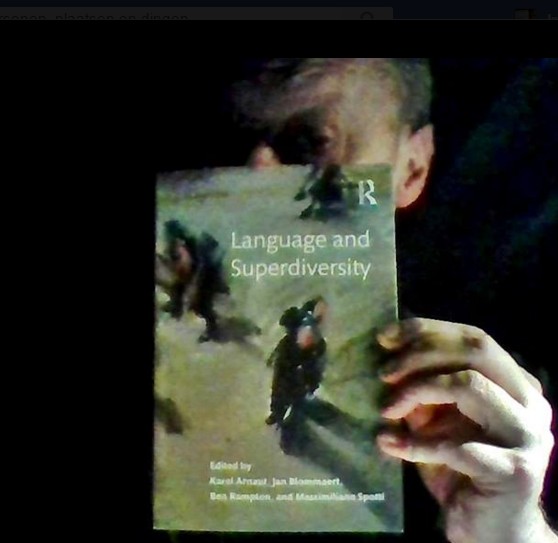
Arnaut, Karel, Jan Blommaert, Ben Rampton & Massimiliano Spotti  (eds. 2016) Language and Superdiversity. New York: Routledge

Blommaert, Jan (2009) Language, asylum and the national order. Current Anthropology 50/4: 415-441.

—– (2013) Ethnography, Superdiversity and Linguistic Landscapes: Chronicles of Complexity. Bristol: Multilingual Matters

—– (2015) Superdiversity old and new. Language and Communication 44: 82-88.

Blommaert, Jan & Piia Varis (2015) Enoughness, accent and light communities: Essays on contemporary identies. Tilburg Papers in Culture Studies, paper 139.

Kroskrity, Paul (ed. 2000) Regimes of Language. Santa Fe: SAR Press

Kroskrity, Paul, Bambi Schieffelin & Kathryn Woolard (eds 1998) Language Ideologies: Theory and Method. New York: Oxford University Press.

Kubota, Ryuko (2014) The multi/plural turn, postcolonial theory and neoliberal multiculturalism: Complicities and implications for Applied Linguistics. Applied Linguistics 2014: 1-22.

Moore, Robert (2013) ‘Taking up speech’ in an endangered language: Bilingual discourse in a heritage language classroom. Tilburg Papers in Culture Studies, paper 69.

Rampton, Ben (1995) Crossing: Language and Ethnicity Among Adolescents. London: Longman

—– (2006) Language in Late Modernity: Interactions in an Urban School. Cambridge: Cambridge University Press.

—– (2014) Gumperz and governmentality in the 21st century: Interaction, power and subjectivity. Tilburg Papers in Culture Studies, paper 117.

Silverstein, Michael (1996) Monoglot ‘standard’ in America: Standardization and metaphors of linguistic hegemony. In Don Brenneis & Ronald Macaulay (eds) The Matrix of Language: 284-306. Boulder: Westview.

—– (1998) Contemporary transformations of local linguistic communities. Annual Review of Anthropology 27: 401-426.

—– (2003) Indexical order and the dialectics of sociolinguistic life. Language and Communication 23: 193-229.

—– (2014) How language communities intersect: Is “superdiversity” and incremental or a transformative condition? Tilburg Papers in Culture Studies, paper 107.

Silverstein, Michael & Greg Urban (eds. 1996) Natural Histories of Discourse. Chicago: University of Chicago Press.


Notes

[1] I must be emphatic: my comments start from sociolinguistics and not Applied Linguistics. I therefore have the advantage of not having to carry the burden of concerns – theoretical and practical – characterizing much of Applied Linguistics, it seems, and – I venture an interpretation – sometimes related to a degree of bad conscience about being in (or close to) the for-profit language industry. In my field, consequently, there is less unease about a possible tension between “theory” and “practice”. Most of what we do is to describe and explain.

[2] INCOLAS stands for the International Consortium for Language and Superdiversity. See, for information,  this website.

[3] Kubota, like many others, appears to have an a priori negative appraisal of institutions and power as necessarily oppressive and “bad for people”. Foucault’s more sophisticated views of power-as-productive and institutions-as-enabling have not been taken on board.

[4] In that sense, and contrary to what Kubota writes, there is nothing “postmodern” about my view, since I reject modernism, which is of course not the same as Modernity. Like Zygmunt Bauman, who speaks of “liquid Modernity” and Scott Lash using “another Modernity”, I do not believe that Modernity has come to an end, but that it has transformed itself. I do believe therefore that classic-modernist frameworks for understanding the present stage of Modernity are hopelessly dated and that this conceptual anachronism constitutes one of the greatest problems of contemporary Modernity, and is one of its most prominent sources of injustice and inequality. See Blommaert (2009) for an illustration of the excluding powers of such dated frameworks.

[5] INCOLAS has made issues of security, policing and surveillance its programmatic priority, and the last INCOLAS meeting (London, Fall 2015) was entirely devoted to these matters. See Rampton (2014) and the introduction to Arnaut et al (2016).

Interview: Jan Blommaert on English, multiligualism and the EU

There is no language without an ‘accent’, because what we call ‘accent-free’ is generally in fact the most prestigious accent.

Published on: http://termcoord.eu/2016/02/interview-with-jan-blommaert/

IMG_1388

Jan Blommaert (Dendermonde, Belgium, 1961) is known as one of the world’s most important sociolinguists and linguistic anthropologists. He is a professor of Language, Culture and Globalisation, as well as the director of the Babylon Center at Tilburg University, the Netherlands. He has significantly contributed to the sociolinguistic globalisation theory, focusing his work on historical and contemporary patterns of the spread of languages and forms of literacy, and on lasting and new forms of inequality emerging from globalisation processes.

1. Let us start with a general question: having studied African history and philology, how did you end up in the more general branch of sociolinguistics?

Africa is an absolute paradise for sociolinguists. In Europe we have all grown up in a monolingual context: ‘normal’ people have just one ‘mother tongue’, which they may possibly supplement with ‘second’, ‘third’ and further languages after they have acquired that first language. Simultaneous multilingualism is regarded as a deviation from the norm, an abnormality, and Belgium is a classic example of this – a multilingual country where simultaneous multilingualism is seen as politically, socially and culturally exceptional and is actively discouraged as being undesirable. Well, if you go to Africa with that kind of ideology of language, you will not understand a thing that is going on around you, because simultaneous multilingualism is the norm there. People have several ‘mother tongues’, so they do not distinguish between languages A and B, although they do distinguish between social contexts A and B. So in fact I had to become a sociolinguist in order to understand language and society there, and my first fieldwork in Tanzania was simply a crash course in advanced sociolinguistics.

2. You clearly seem to be in the Eurosceptic camp. To give an example, let me cite one of your articles: “(…) the levels of language skills laid down by the EU (A1, A2 etc.) are abstractions which have nothing to do with the reality of communication[1]”. Why do you regard them as abstractions which have nothing to do with reality?

I am Eurocritical, but not a Eurosceptic, and I adopt that position on the basis of a strong belief in the potential of Europe. I want it to work and keep its promises, and, as a concerned European citizen, I am critical when it fails to do so. The example of the levels of language skills is typical: a bureaucratic and standardised solution is chosen for something which essentially is amenable only to ‘made to measure’ approaches and flexibility. There are various reasons why I say this. Firstly, there can be no conceivable language test that will unequivocally measure the practical language skills of the language user in real situations. A person who scores 100% in English at school will not necessarily – and not on that account – understand English as it is spoken in Leeds or Belfast, or the texts of rappers such as Snoop Dogg. That is a general fact: what language tests may perhaps indicate is competence at language learning; but they do not test the reality of communication. Secondly, and this is something which is already implicit in the first point: as a rule, people are tested for competence in using a standard variant of a language, and as we know, a standard variant is one that no one genuinely uses. There is no language without an ‘accent’, because what we call ‘accent-free’ is generally in fact the most prestigious accent. In that respect, the learned standard variant, paradoxically, is often extremely marginal in society, and it is necessary to learn the local accents and variants in order to be ‘integrated’.

Take Leeds or Belfast again, in the case of English. When you learn to communicate, after all, you do so in a real social environment, and during the learning process it is vital to absorb the ‘local colour’ as well, the language variants which really make us part of a particular social complex. Why? That is the third point: because language is the major, unmistakable social filter which serves as a basis for all manner of categorisations – both positive and negative. A ‘Moroccan’ accent which a person speaking Dutch has failed to overcome at level A1 will not be eliminated by passing the C1 test, and in that respect too, the European levels of language skills are an abstraction which has nothing to do with the reality of communication. If one has the impression that a newcomer speaks Dutch inadequately when he has passed level A2, the impression will not change when they pass level B2. In reality, language use has an emblematic impact: certain features, no matter how minimal, result in acceptance or exclusion – think of the spelling mistakes that people make in Dutch when writing the identical-sounding endings -d and -t, which, if they are applying for a job, are quite likely to result in their being rejected out of hand. To the extent that levels of language skills are associated in people’s minds with expectations of actual social and cultural ‘integration’, they are a fiction.

3. How then could one – ideally – assess a person’s language prowess in a meaningful way?

It is not really clear to me why one should even want to assess levels of language skills. What level should be taken as the yardstick, anyway? What one needs at the hairdresser’s or the baker’s? At work (and in that case, which work)? At a parents’ evening at school in order to speak to the maths teacher? There is no such thing as ‘a’ (single and unequivocal) level of language skill. Each of us combines in himself a whole range of different levels of language skills at any given moment in our lives. I am highly articulate when discussing language matters with a fellow researcher, yet struggle to converse with an insurance agent, a car dealer, a software developer or a neurologist. So how would you define my level, and how can we assess it?

4. In the past, the EU Institutions imposed jargon and terminology on the Member States, the ‘prescriptive’ approach. Nowadays, the situation has been reversed, and specific terms are supplied to the terminology databases of the EU Institutions from the Member States – the ‘descriptive’ approach. Do you favour the prescriptive or the descriptive approach?

When it comes down to it, this is a practical question: what works best? The EU has always adopted a very inflexible (and therefore unrealistic) attitude towards language and languages, due to the sensitivities of a number of Member States. For a time therefore, imitating scientists, and in order to be ‘objective’, it was thought that a completely standardised jargon would ensure the greatest clarity, but then it came to be realised that the resultant texts alienated local target groups emotionally, and that it was therefore necessary to permit greater diversity. Languages are not interchangeable on a one-to-one basis, social and cultural systems even less so, and with the increase in the number of Member States, the volume of potential differences in meaning and misunderstandings increases objectively. Only a relaxed and realistic attitude towards language issues can provide a solution here: we need to accept that the language situation is a complex of elements which is always in flux and that the response constantly needs to be changed and adapted to new circumstances, and with one practical question in mind: what works best?

5. English is a lingua franca at the EU Institutions, for example. What do you think that this victory of English means for all the other languages in the EU?

That is only partially true: the ‘lingua franca’ is not a single language but a stratified and functionally structured multilingualism. In the jargon we call this ‘languaging’: doing language, language as a verb. People use one language or another, or mixtures of them, as dictated by the situation, the interlocutors or the subject, and they immediately switch to a different code if these factors change. The use of certain forms of English has not eliminated the other languages, nor will it in future: English has taken up a position alongside the other languages as a practical instrument for certain forms of interaction in certain settings, with certain interlocutors and on certain subjects. But a conversation in English with a counterpart from another Member State is interrupted by excursions into one’s own language with colleagues or other people from one’s own country, in between times we greet other colleagues in yet other languages, and the memoranda and minutes on discussions which were conducted in English circulate in various languages and are discussed in just as many. It would be mistaken to think that the ‘official’ language is also a language which eliminates every other. In reality, it is merely the language of the official part of the communication, the part which assumes an urbi et orbi role. But that is in reality only a small fragment of the world of communication in which we live and move and have our being. Here too, as far as I am concerned there is only one guiding principle: what works best? And a relaxed attitude is the best compass for navigating in an extremely complex multilingual environment.

6. And what does the status of English as a world lingua franca mean for the development of the English language itself?

The answer is the same as that to the previous question: English – in a wide range of forms – is becoming part of the multilingual repertoires and the ‘languaging’ practices of more and more people, and in such contexts it is used for certain forms of communication, while other languages continue to be used for others. For example, English has become the worldwide language of academic publishing. But there are two observations to be made about this. Firstly, the English in question is of a highly specific kind – academic English – and that is not the kind of English you can use if you need to explain a problem with the outflow pipe from your bath to a plumber in Chicago. Secondly, it is the language of academic writing, but not of academic speech. We still mainly teach in local or national languages, while nowadays writing in English. Our academic work has therefore, strictly speaking, not been ‘anglicised’, but it has become multilingual. That is the stratified and functionally structured multilingualism that I mentioned earlier, and in that sense we have all become English-‘languagers’.

What consequences does this then have for English itself? There is a sociolinguistic rule which states that a language which grows very large disintegrates into innumerable new variants, and that is precisely what we are witnessing in the case of English around the world. ‘English’ now stands for an extremely motley and rapidly changing continuum of variants, ranging from varieties which merely resemble English to others which actually are English, and in the latter category we observe an enormous innovatory dynamic which to a large extent is operating within a new globalised popular culture and through social media. This is incidentally the first time that a great deal of change in language usage has started to originate not in the spoken variants but in the written forms. Consider, for example, the new ways of writing that we use in text messages and chats, such as “CU” “w8” or “thx”.

7. Many cities in Europe are increasingly becoming places of superdiversity, such as Brussels, London, Luxembourg, etc. Is language a divisive element or is it on the contrary what binds people together in cities with superdiversity?

Not surprisingly, that is a complex issue, because there are various levels to be examined here, and we must be sure to bear in mind the previous observations. Firstly, there is a political and ideological level, and at that level, superdiversity is regarded as a problem and an obstacle. An emphasis on uniformity and homogeneity is the classic response of modernity to growing diversity. Secondly, there is an objective potential for growing communication problems which are simply due to demolinguistic change in our society, where a hundred or more languages are sometimes represented within a very small area. That is not only a source of potential, it is also an operational problem which expresses itself in so-called ‘frontline sectors’: education, the police and judicial system, health care and officialdom. There we encounter an escalating translation problem which is virtually insoluble. Let us take a simple example: refugees from Syria, Iraq, Libya and Yemen are nearly all classified as ‘Arabic’-speakers. However, official court interpreters – many of whom come from Moroccan backgrounds – often have great difficulty in understanding their varieties of Arabic, which creates both practical and political/legal problems.

But there is, thirdly, the factor which we discussed previously: ‘languaging’. In superdiverse environments, it is rare to find a confusion of tongues such as we associate with the Tower of Babel: rather, what one finds is an extremely flexible and tolerant attitude towards multilingualism, in which seriously deficient forms of Dutch often form the backbone. So people find their own way in the situation of extreme multilingualism which we can observe emerging in practically every city, and in that sense we see, contrary to the first two points, that it is in fact perfectly possible to have social cohesion, social interaction and a sense of community in superdiverse environments. The language problems that occur need not be underestimated, but we should not overestimate them either. We certainly need a more effective multilingual infrastructure in our cities, that much is clear – even if politicians do not agree. But we should also be aware that our society will not collapse if it becomes superdiverse. Indeed: in the past 15 to 20 years, our society has in fact become superdiverse in a way which has hardly been noticed. In lectures on the subject, we present statistics on the increase in the foreign nationalities represented in Ostend in the past 20 years. That increase is quite remarkable, and people tend to be very surprised when their attention is drawn to it, because it has never actually struck them before. That seems to me to be good news.

[1] https://jmeblommaert.wordpress.com/2013/01/17/voor-de-onderzoeker-hoe-vlaanderen-in-2013-argumenteert/

About the interviewer

CorineKlipCorine Klip, study visitor at TermCoord. Born in the Netherlands in 1973 (Amsterdam), she moved to Luxembourg in 1984 and attended the European School as a child of a EU-official. After graduating from the European School, she obtained a Bachelor’s Degree in Communication Sciences in Ghent and worked for nearly 18 years in the financial industry in Luxembourg. Being always fascinated by language and multilingualism in all its forms, she decided to take a double sabbatical break from the financial industry in order to continue studying multilingualism and multiculturalism. She is currently doing a Master Degree in Learning and Communication in Multilingual and Multicultural Contexts at the University of Luxembourg.

Sociolinguistic superdiversity under construction: A response to Stephen May.

ScreenHunter_736 Feb. 10 12.00

Jan Blommaert

I have read with great interest the summary of a talk given by Stephen May at the MOSAIC Centre in Birmingham, entitled “Linguistic Superdiversity as a ‘new’ theoretical framework in applied linguistics: Panacea or Nostrum?”

https://tlangblog.wordpress.com/2016/02/05/linguistic-superdiversity-panacea-or-nostrum/

Stephen is critical of sociolinguistic superdiversity work because it overlooks several issues, many of which revolve around the position of indigenous (and endangered) languages, neglected, it seems, by an overly urban and metropolitan (ethnocentric) set of preferences in research – “metronormativity”.

I would say the following in response to this summary (not having access to Stephen’s own words).

  1. There appears to be some stereotyping here of the “superdiversity tradition”, which is seriously premature, in my view, since no bibles of it have been published and the field is moving continually and very rapidly; and which consequently also misses some crucial recent work. I’m thinking in particular of the special issue of Language and Communication (2015), which, to some extent, represents the “American” take on superdiversity; and of the recently published volume “Language and Superdiversity” (Arnaut et al, 2016). See http://www.sciencedirect.com/science/journal/02715309/44 and https://www.routledge.com/products/9781138844582
  2. In both sources, an earlier made point (but often overlooked in commentaries) is given even more weight: the fact that, for us working on sociolinguistic superdiversity, the internet is a key to understanding the paradigmatic ramifications of superdiversity. See for instance, in the L&C issue, the paper by Paja Faudree in which Mexican traditions are given a new lease of life, in a constantly transforming shape, in the diaspora through online re-modulation; and several papers in the Arnaut et al volume. For concise statements on this issue, see also https://www.academia.edu/10371446/Commentary_Superdiversity_old_and_new and https://www.tilburguniversity.edu/upload/ba515695-257b-4dd0-b030-b52a158c7a42_TPCS_160_Blommaert.pdf
  3. Note that this particular emphasis on “virtual” space represents an important departure from most of traditional sociological and anthropological thought, but also from the phenomenology used in what could be called the “Vertovec tradition” of superdiversity research, which concentrates on migration flows in “offline” space. This fundamental difference is usually and remarkably overlooked, and work such as that of Rampton, Blackledge/Creese and myself is wrongly placed in a direct lineage with Vertovec’s classic definitions of superdiversity. The introduction of the Arnaut et al volume is nonetheless clear in this respect:  https://www.academia.edu/11260611/Superdiversity_and_Sociolinguistics  and this alternative emphasis has been there right from the very first formulations of our approach. See for the earliest formulation  http://www.mmg.mpg.de/fileadmin/user_upload/Subsites/Diversities/Journals_2011/2011_13-02_art1.pdf
  4. The focus on the online space is of tremendous theoretical and methodological relevance; the frequency with which it is overlooked as a crucial feature of our approach is amazing, especially since it is exactly this online-offline nexus which is entirely new (no such thing existed in sociocultural, political and historical phenomenology until the final decades of the 20th century – this, I hope, shall not be disputed) and offers a formidable potential for empirical and theoretical reformulation. It questions and at least qualifies, for instance, widely used conceptualizations of social space, including, prominently, traditional distinctions between “centers” and “peripheries” (and thus also ideas of “metropolitan” versus “indigenous” languages, and between “urban” and “rural”). See for a statement on the increasingly problematic notion of the “urban”,  https://alternative-democracy-research.org/2015/05/20/marxism-and-urban-culture-a-review/
  5. It also qualifies and amends widespread notions of “culture”, “identity” and “social groups”. Ben Rampton’s work, as well as that of Blackledge & Creese and others, has been influential in this. For my own views on this, see the following papers: https://www.academia.edu/10789675/Commentary_Culture_in_superdiversity and https://www.academia.edu/15620712/Conviviality_and_collectives_on_social_media_Virality_memes_and_new_social_structures and the collection of essays in https://www.tilburguniversity.edu/upload/5c7b6e63-e661-4147-a1e9-ca881ca41664_TPCS_139_Blommaert-Varis.pdf
  6. As for the fact that the “margins” are no longer immune to “metropolitan” developments, again there are emphatically clear statements on this. See for instance, https://www.academia.edu/6772025/Globalization_in_the_margins_Toward_a_re-evaluation_of_language_and_mobility._Wang_et_al._2014_
  7. In view of the ways in which this paradigm dislodges the established spatial imagination in social research, pace the previous points, I wonder what the claim of “metronormativity” would be about. I’m afraid it can only be held by those who stick to pre-virtual spatial ontologies and conveniently choose to overlook what the presence of the e-space (the largest social space on earth) has done to contemporary societies: “Eurocentrism” is no longer a stable term in the era of Facebook and Google. In case the response would be that precisely the focus on the internet constitutes metronormativity, I’d like to remind those who take this view of something established by Braudel and Wallerstein in consecutive versions of World-Systems Analysis: that the presence of a new infrastructure in parts of the world system affects the entire system: those who lack access to it are pushed deeper into the periphery, for instance. The Wang et al paper mentioned in point 6 above develops this point at length.
  8. Observe also (and this is now widely acknowledged) that the paradigmatic potential of sociolinguistic superdiversity compels us to focus on registers rather than languages. We arrive at a far more specific and nuanced view of the objects of sociolinguistic processes – their ontology – and this shift does not in any way preclude work on “marginal” languages, sites or communities. A prime example of this is Fie Velghe’s dissertation on mobile phone texting as a tool for literacy instruction in a marginalized township near Cape Town. See, for a sample, https://www.tilburguniversity.edu/upload/cdcdd501-1a7b-4af2-803d-dd51dd6623cd_tpcs%20paper6.pdf
  9. There is, then, the issue of “dehistorization”. This critique, I believe, is justified when applied to some of the “Vertovecian” work, in which we do see snapshot ethnography coupled with a kind of ”diversity euphoria” which I shall comment on below. It is also justified when applied to some superficial Linguistic Landscape Studies. Our own work, however, has been absolutely clear and explicit on the fact that superdiversity, precisely, forces us towards historicizing ethnographic work on the present. See, for instance, http://www.multilingual-matters.com/display.asp?K=9781783090402 and https://alternative-democracy-research.org/2016/01/05/the-conservative-turn-in-linguistic-landscape-studies/
  10. Finally, there is the often heard allegation that sociolinguistic superdiversity would turn a blind eye to issues of power and inequality, contemporary as well as historical – the “diversity euphoria” mentioned above. Again, the introductory chapter of Arnaut et al. can serve as a reminder that it is precisely the institutional response to superdiversity – increasing surveillance, negation and erasure of difference – that should occupy researchers presently. In the Arnaut et al. volume, the entire final section is devoted to “policing complexity”. In the L&C volume, one can turn to the contributions of Marco Jacquemet (on asylum applications) and Rob Moore (on EU language policy) for illustrations. The fate of “minority” languages is elaborately addressed there. See also Rampton’s pretty outspoken position on issues of power and inequality in sociolinguistic superdiversity: https://www.tilburguniversity.edu/research/institutes-and-research-groups/babylon/tpcs/item-paper-117-tpcs.htm
  11. Just as an illustration of the analytical potential of inquiry informed by this perspective, the following example. Few would consider Mandarin Chinese a “minority” language, let alone an “endangered” one. In a diaspora situation, however, it may become a minority language both in official-administrative status (nonexistent) and in sociolinguistic position within the space of the nation-state (marginal). We know that globalization, in that sense, creates and reshuffles language hierarchies. And this means that there is nothing static or absolute to the status of a language as “minority” language – any language can be “minorized” by being moved from point A to point B. But that is not the end of it. In a diasporic situation – take The Netherlands as an example – Mandarin Chinese can be a minority language but simultaneously (here comes the scalar fractality which is so often central to our analysis) a majority language vis-à-vis the Cantonese of the previously dominant “Chinese” diaspora community, who see themselves forced to learn and use Mandarin in the “offline” public space, while (here comes a third scalar-fractal level) maintaining it in online spaces. Similar processes affect other migrant “minorities” whose (very large) heritage language is subject to similar patterns of fractal restratification – think, e.g., of the Gujarati and Bengali communities investigated by Creese and Blackledge. Such complex processes of scalar-fractal restratifications illuminate the predicament of “minorities” in important (if not always welcome) ways and teach us that functional stratification across different scale levels may be the direction to look at in studies on language endangerment. See for examples  https://www.academia.edu/8482298/Dutch-Chinese_repertoires_and_language_ausbau_in_superdiversity_A_view_from_digital_media._Juffermans_Blommaert_Kroon_and_Li_2014_ and  https://www.academia.edu/18066964/Towards_a_sociolinguistics_of_superdiversity

I do fully understand the concerns voiced by Stephen May and others, but I also insist on a fair and informed reading of the work they propose to put under critical scrutiny. Because, often, I encounter “absences” that are in actual fact richly developed presences, and “blind spots” that are in actual fact explicitly stated foci of attention – an attack on work that one would wish to see lacking of these foci, it thus appears. We are quite impatient with those (not including Stephen, though) who, on the basis of such incomplete readings, consider our views refuted and recommend staying within the safe perimeter of a Durkheimian-Parsonian (methodologically nationalist and empirically anachronistic) sociolinguistics in which nothing needs to be changed.

I do not wish to argue here that sociolinguistic superdiversity work, in its present state, has provided all the answers to all the questions. Far from that. Sociolinguistic superdiversity, in my view, is neither a panacea nor a nostrum. It’s just a potentially fertile idea which people such as I have chosen to explore and develop, if for nothing else just to see what its limits are. It’s very much under construction, and I often have to react to criticism premised on an imagined “codex” of work which upon closer inspection is all but absent. There is a growing body of explorative, inquisitive and bold research which has yielded several results that have acquired a degree of currency – think of translanguaging, the focus on registers rather than languages, and the redefinition of “speakers” of languages. Furthermore, the impact of such work on higher-level theorizing about language and society is becoming clear as well and awaits a first synthesis. Some of the references given above could serve as pointers towards such a synthesis. For it would be wrong to qualify the work on sociolinguistic superdiversity as “micro” in nature: it is a nano-science of very big things.

Thus the fact that not everything has been done does not mean that nothing has been done. I take Stephen May’s critical comments therefore as an exhortation to do more and better, and to take on topics until now rarely addressed from the paradigmatic angle of sociolinguistic superdiversity.

by-nc

Linguistic superdiversity: panacea or nostrum?

TLANGblog's avatartlang blog

By Caroline Tagg, Open University 

Screen Shot 2016-02-05 at 09.37.36.png

Clearly jet-lagged and yet still impressively articulate, Professor Stephen May of the University of Auckland, New Zealand, delivered a thought-provoking talk on on 3rd February 2016 at the University of Birmingham. The talk was organised by University’s MOSAIC Centre for Research on Multilingualism, and was titled: ‘Linguistic superdiversity as a “new” theoretical framework in applied linguistics: panacea or nostrum?’ It was a useful reminder not to stop critically reflecting on the paradigms and theoretical concepts with which we align ourselves.

Stephen was keen to stress his support for a superdiversity lens and for reconceptualisations of language that are now often associated with superdiversity: translanguaging, flexible bilingualism, metrolingualism, and so on. However, he raised questions about the role that a superdiversity approach could play when it came to language rights and revitalisation, and minority language education. These questions were underpinned by oft-cited criticisms of superdiversity: namely…

View original post 356 more words

New forms of diaspora, new forms of integration

Migrants smartphones

Jan Blommaert 

“Integration” continues to be used as a keyword to describe the processes by means of which outsiders – immigrants, to be more precise – need to “become part” of their “host culture”. I have put quotation marks around three crucial terms here, and the reasons why will become clear shortly. “Integration” in this specific sense, of course, has been a central sociological concept in the Durkheim-Parsons tradition. A “society” is a conglomerate of “social groups” held together by “integration”: the sharing of (a single set of) central values which define the character, the identity (singular) of that particular society (singular). And it is this specific sense of the term that motivates complaints – a long tradition of them – in which immigrants are blamed for not being “fully integrated”, or more specifically, “remaining stuck in their own culture” and “refusing” to integrate in their host society.

Half a century ago, in a trenchant critique of Parsons, C. Wright Mills (1959: 47) observed that historical changes in societies must inevitably involve shifts in the modes of integration. Several scholars documented such fundamental shifts – think of Bauman, Castells, Beck and Lash – but mainstream discourses, academic and lay, still continue to follow the monolithic and static Parsonian imagination. I what follows I want to make an empirical point in this regard, observing that new modes of diaspora result in new modes of integration.

In a splendid MA dissertation, Jelke Brandehof (2014) investigated the ways in which a group of Cameroonese doctoral students at Ghent University (Belgium) used communication technologies in their interactions with others. She investigated the technologies proper – mobile phone and online applications – as well as the language resources used in specific patterns of communication with specific people. Here is a graphic representation of the results for one male respondent (Brandehof 2014: 38).

ScreenHunter_732 Feb. 03 11.42

This figure, I would argue, represents the empirical side of “integration” – real forms of integration in contemporary diaspora situations. Let me elaborate this.

The figure, no doubt, looks extraordinarily complex; yet there is a tremendous amount of order and nonrandomness to it. We see that the Cameroonian man deploys a wide range of technologies and platforms for communication: his mobile phone provider (with heavily discounted rates for overseas calls) for calls and text messages, skype, Facebook, Beep, Yahoo Messenger, different VOIP systems, Whatsapp and so forth. He also uses several different languages: Standard English, Cameroonian Pidgin, local languages (called “dialects” in the figure), and Fulbe (other respondents also reported Dutch as one of their languages). And he maintains contacts in at least three different sites: his own physical and social environment in Ghent, his “home environment” in Cameroon, and the virtual environment of the “labor market” in Cameroon. In terms of activities, he maintains contacts revolving around his studies, maintaining a social and professional network in Ghent, job hunting on the internet, and an intricate set of family and business activities back in Cameroon. Each of these activities – here is the order and nonrandomness – involves a conscious choice of medium, language variety and addressee. Interaction with his brother in Cameroon is done through smartphone applications and in a local language, while interactions with other people in the same location, on religious topics, are done in Fulbe, a language marked as a medium among Muslims.

Our subject is “integrated”, through the organized use of these communication instruments, in several “cultures” if you wish. He is integrated in his professional and social environment in Ghent, in the local labor market, in the Cameroonian labor market, and in his home community. Note that I use a positive term here: he is “integrated” in all of these “zones” that make up his life – he is not “not integrated”, I insist – because his life develops in real synchronized time in these different zones, and all of these zones play a vital part in this subject’s life. He remains integrated as a family member, a friend, a Muslim and a business partner in Cameroon, while he also remains integrated in his more directly tangible environment in Ghent – socially, professionally and economically. This level of simultaneous integration across “cultures” (if you wish) is necessary: our subject intends to complete his doctoral degree work in Ghent and return as a highly qualified knowledge worker to Cameroon. Rupturing the Cameroonese networks might jeopardize his chances of reinsertion in a lucrative labor market (and business ventures) upon his return there. While he is in Ghent, part of his life is spent there while another part continues to be spent in Cameroon, for very good reasons.

I emphasized that our subject has to remain integrated across these different zones. And the technologies for cheap and intensive long-distance communication enable him to do so. This might be the fundamental shift in “modes of integration” we see since the turn of the century: “diaspora” no longer entails a total rupture with the places and communities of “origin”; neither, logically, does it entail a “complete integration” in the host community, because there are instruments that enable one to lead a far more gratifying life, parts of which are spent in the host society while other parts are spent elsewhere. Castells” “network society” (1996), in short. We see that diasporic subjects keep one foot in the “thick” community of family, neighborhood and local friends, while they keep another foot – on more instrumental terms – in the host society and yet another one in “light” communities such as internet-based groups and the labor market. Together, they make up a late-modern “diasporic life”.

There is nothing exceptional or surprising to this: the jet-setting European professional business class does precisely the same when they go on business trips: smartphones and the internet enable them to make calls home and to chat with their daughters before bedtime, and to inform their social network of their whereabouts by means of social media updates. In that sense, the distance between Bauman’s famous “traveler and vagabond” is narrowing: various types of migrants are presently using technologies previously reserved for elite travelers. And just as the affordances of these technologies are seen as an improvement of an itinerant lifestyle by elite travelers, it is seen as a positive thing by these other migrants, facilitating a more rewarding and harmonious lifestyle that does not involve painful ruptures of existing social bonds, social roles, activity patterns and identities.

What looks like a problem from within a Parsonian theory of “complete integration”, therefore, is in actual fact a solution for the people performing the “problematic” behavior. The problem is theoretical, and rests upon the kind of monolithic and static sociological imagination criticized by C. Wright Mills and others, and the distance between this theory and the empirical facts of contemporary diasporic life. Demands for “complete integration” (and complaints about the failure to do so) can best be seen as nostalgic and, when uttered in political debates, as ideological false consciousness. Or more bluntly, as surrealism.

References

Brandehof, Jelke (2014) Superdiversity in a Cameroonian Diaspora Community in Ghent: The Social Structure of Superdiverse Networks. MA dissertation, Tilburg University (unpublished).

Castells, Manuel (1996) The Rise of the Network Society. London: Blackwell.

Mills, C. Wright (1959 [1967]) The Sociological Imagination. Oxford: Oxford University Press.

Another 3 million refugees? Really?

Nando Sigona's avatarPostcards from ...

Another illustration of how the numbers of the refugee/migration crisis may be inflated, misrepresented or manipulated was brought to my attention by Professor David Ingleby (see my article on Frontex for another example). Many media are reporting with definitive headlines that the EU is expecting ‘another 3 million refugees and migrants in 2016′ (emphasis added). A few examples below:

independent3m

skynews3m

yahoo3m

Even The Guardian, although it didn’t put the 3 million figure in a title, says “more than three million more people are expected to arrive in the EU by the end of next year“, and so on.

The key elements of the headlines are: 1) ‘another’ which reads as ‘on top of the current arrivals’, and b)  ‘by/in 2016’ which reads either as ‘from now to the end of 2016’ or  ‘in 2016 alone’. Both elements however one interprets them are wrong.

In fact, the EC forecast they refer to  is not…

View original post 156 more words

Is a distribution key system the solution to the EU’s refugee crisis?

Nando Sigona's avatarPostcards from ...

by Nando Sigona

The Dublin regulation in its three incarnations has attracted plenty of criticism on various grounds and from various statutory and non-statutory actors – the most noticeable perhaps being it is a system that impact unevenly on EU member states, with countries at the EU’s southern border particularly exposed because of their position. These countries have traditionally responded to the pressure imposed by the Dublin regulation in two ways – formally, demanding more solidarity from other member states and a different system altogether; informally, letting people slip through their bureaucratic net not finger-printing them (see Italy) or allowing such poor reception conditions for asylum seekers to force other member states to stop returning so called ‘Dublin cases’ on human rights ground (see Greece).

The events of the last months have de facto led to the suspension of the Dublin regulation and further intensified the call for a substantial revamp of…

View original post 375 more words

It’s the culture, stupid! Or is it?

thomashyllanderiksen's avatarEriksen's blog

The events in Cologne have sparked controversies across Europe. This time, the topic is not the economic and social costs of the refugee crisis, but questions concerning culture and gender. We need a proper language in which to address these issues.

A shorter version of this article was published in Norwegian in Morgenbladet on 15 January 2016.

There is no simple answer as to what exactly happened in Cologne on New Year’s Eve. There was a large number of people partying in the city centre, in varying states of intoxication, and no version of the events is the only valid or possible one. You and I may easily perceive and interpret identical situations in quite different ways, even if we were both present. But a few facts seem indisputable. A rather large number of young men (a few hundred? a thousand?), most of them with a background in Arab-speaking countries…

View original post 3,140 more words

Research training and the production of ideas

21382110-Business-Ideas-conceptual-A-businessman-watching-the-city-with-big-ideas--Stock-Photo

Jan Blommaert 

Can we agree that Albert Einstein was a scientist? That he was a good one (in fact, a great one)? And that his scientific work has been immeasurably influential?

I’m asking these silly questions for a couple of reasons. One: Einstein would, in the present competitive academic environment, have a really hard time getting recognized as a scientist of some stature. He worked in a marginal branch of science – more on this in a moment – and the small oeuvre he published (another critical limitation now) was not written in English but in German. His classic articles bore titles such as “Die vom Relativätsprinzip geforderte Trägheit der Energie” and appeared in journals called “Annalen der Physik” or “Beiblätter zu den Annalen der Physik”. Nobody would read such papers nowadays.

Two, his work was purely theoretical. That means that it revolved around the production of new ideas, or to put it more bluntly, around imagination. These forms of imagination were not wild or unchecked – it wasn’t “anything goes”. They were based on a comprehensive knowledge of the field in which he placed these ideas (the “known facts of science”, one could say, or “the state of the art” in contemporary jargon ), and the ideas themselves presented a synthesis, sweeping up what was articulated in fragmentary form in various sources and patching up the gaps between the different fragments. His ideas, thus, were imagined modes of representation of known facts and new (unknown but hypothetical and thus plausible or realistic) relations between them.

There was nothing “empirical” about his work. In fact, it took decades before aspects of his theoretical contributions were  supported by empirical evidence, and other aspects still await conclusive empirical proof. He did not construct these ideas in the context of a collaborative research project funded by some authoritative research body – he developed them in a collegial dialogue with other scientists, through correspondence, reading and conversation. In the sense of today’s academic regime, there was, thus, nothing “formal”, countable, measurable, structured, justifiable, or open to inspection to the way he worked. The practices that led to his theoretical breakthroughs would be all but invisible on today’s worksheets and performance assessment forms.

As for “method”, the story is even more interesting. Einstein would rather systematically emphasize the disorderly, even chaotic nature of his work procedures, and mention the fact (often also confirmed by witnesses) that, when he got stuck, he would leave his desk, papers and notebooks, pick up his violin and play music until the crucial brainwave occurred. He was a supremely gifted specialized scholar, of course, but also someone deeply interested (and skilled) in music, visual art, philosophy, literature and several other more mundane (and “unscientific”) fields. His breakthroughs, thus, were not solely produced by advances in the methodical disciplinary technique he had developed; they were importantly triggered by processes that were explicitly non-methodical and relied on “stepping out” of the closed universe of symbolic practices that made up his science.

0000

Imagine, now, that we would like to train junior scholars to become new Einsteins. How would we proceed? Where would we start?

Those familiar with contemporary research training surely know what I am talking about: students are trained to become “scientists” by doing the opposite of what turned Einstein into the commanding scientist he became. The focus these days is entirely – and I am not overstating this – on the acquisition, development and refining of methods to be deployed on problems which in turn are grounded in assumptions by means of hypotheses. Research training now is the training of practicing that model. The problems are defined by the assumptions and discursively formulated through the hypotheses – so they tolerate little reflection or unthinking, they are to be adopted. And what turns the student’s practices into “science” is the disciplined application of acquired methods to such problems resting on such assumptions. This, then, yields scientific facts either confirming or challenging the “hypotheses” that guided the research, and the production of such facts-versus-hypotheses is called scientific research. Even more: increasingly we see that only this procedure is granted the epithet of “scientific” research.

The stage in which ideas are produced is entirely skipped. Or better, the tactics, practices and procedures for constructing ideas are eliminated from research training. The word “idea” itself is often pronounced almost with a sense of shame, as an illegitimate and vulgar term better substituted by formal jargonesque (but equally vague) terms such as “hypothesis”. While, in fact, the closest thing to “idea” in my formulation is the term “assumption” I used in my description of the now dominant research model. And the thing is that while we train students to work from facts through method to hypotheses in solving a “problem”, we do not train them to questions the underlying assumptions that formed both the “problem” they intend to address and the epistemological and methodological routes designed to solve such problems. To put it more sharply, we train them in accepting a priori the fundamental issues surrounding and defining the very stuff they should inquire into and critically question: the object of research, its relations with other objects, the “evidence” we shall accept as elements adequately constructing this object, and the ways in which we can know, understand and communicate all this. We train them, thus, in reproducing – and suggestively confirming – the validity of the assumptions underlying their research.

“Assumptions” typically should be statements about reality, about the fundamental nature of phenomena as we observe and investigate them among large collectives of scientists. Thus, an example of an assumption could be “humans produce meaning through the orderly grammatical alignment of linguistic forms”. Or: “social groups are cohesive when they share fundamental values, that exist sociocognitively in members’ minds”.  Or “ethnicity defines and determines social behavior”. One would expect such assumptions to be the prime targets of continuous critical reassessment in view (precisely) of the “facts” accumulated on aspects that should constitute them. After all, Einstein’s breakthroughs happened at the level of such assumptions, if you wish. Going through recent issues of several leading journals, however, leads to a perplexing conclusion: assumptions are nearly always left intact. Even more: they are nearly always confirmed and credentialed by accumulated “facts” from research – if so much research can be based on them, they must be true, so it seems. “Proof” here is indirect and by proxy, of course – like miracles “proving” the sacred powers of an invoked Saint.

Such assumptions effectively function not as statements about the fundamental nature of objects of research, open for empirical inspection and critique, but as axiomatic theses to be “believed” as a point of departure for research. Whenever such assumptions are questioned, even slightly, the work that does so is instantly qualified as “controversial” (and, in informal conversations, as “crackpot science” or “vacuous speculation”). And “re-search”, meaning “searching again”, no longer means searching again da capo, from step 1, but searching for more of the same. The excellent execution of a method and its logic of demonstration is presented as conclusive evidence for a particular reality. Yes, humans do indeed produce meaning through the orderly grammatical alignment of linguistic forms, because my well-crafted application of a method to data does not contradict that assumption. The method worked, and the world is chiseled accordingly.

0000

Thus we see that the baseline intellectual attitude of young researchers, encouraged or enforced and positively sanctioned – sufficient, for instance, to obtain a doctoral degree and get your work published in leading journals, followed by a ratified academic career – is one in which accepting and believing are key competences, increasingly even the secret of success as a researcher. Not unthinking the fundamental issues in one’s field, and abstaining from a critical inquisitive reflex in which one looks, unprompted, for different ways of imagining objects and relations between them, eventually arriving at new, tentative assumptions (call them ideas now) – is seen as being “good” as a researcher.

The reproductive nature of such forms of research is institutionally supported by all sorts of bonuses. Funding agencies have a manifest and often explicit preference for research that follows the clear reproductive patterns sketched above. In fact, funding bodies (think of the EU) often provide the fundamental assumptions themselves and leave it to researchers to come up with proof of their validity. Thus, for instance, the EU would provide in its funding calls assumptions such as “security risks are correlated with population structure, i.e. with ethnocultural and religious diversity” and invite scientific teams to propose research within the lines of defined sociopolitical reality thus drawn. Playing the game within these lines opens opportunities to acquire that much-coveted (and institutionally highly rewarded) external research funding – an important career item in the present mode of academic politics.

There are more bonuses. The reproductive nature of such forms of research also ensures rapid and high-volume streams of publications. The work is intellectually extraordinarily simple, really, even if those practicing it will assure us that it is exceedingly hard: no fundamental (and often necessarily slow) reflection, unthinking and imaginative rethinking are required, just the application of a standardized method to new “problems” suffices to achieve something that can qualify as (new or original) scientific fact and can be written down as such. Since literature reviews are restricted to reading nothing fundamentally questioning the assumptions, but reading all that operates within the same method-problem sphere, published work quickly gains high citation metrics, and the journals carrying such work are guaranteed high impact factors – all, again, hugely valuable symbolic credit in today’s academic politics. Yet, reading such journal issues in search for sparkling and creative ideas usually turns into a depressing confrontation with intellectual aridity. I fortunately can read such texts as a discourse analyst, which makes them at least formally interesting to me. But that is me.

0000

Naturally, but unhappily, nothing of what I say here is new. It is worth returning to that (now rarely consulted) classic by C. Wright Mills, “The Sociological Imagination” (1959) to get the historical perspective right. Mills, as we know, was long ago deeply unhappy with several tendencies in US sociology. One tendency was the reduction of science to what he called “abstracted empiricism” – comparable to the research model I criticized here. Another was the fact that this abstracted empiricism took the “grand theory” of Talcott Parsons for granted as assumptions in abstracted empirical research. A poor (actually silly) theory vulnerable to crippling empirical criticism, Mills complained, was implicitly confirmed by the mass production of specific forms of research that used the Parsonian worldview as an unquestioned point of departure. The title of his book is clear: in response to that development, Mills strongly advocated imagination in the sense outline earlier, the fact that the truly creative and innovative work in science happens when scientists review large amounts of existing “known facts” and reconfigure them into things called ideas. Such re-imaginative work – I now return to a contemporary vocabulary – is necessarily “slow science” (or at least slower science), and is effectively discouraged in the institutional systems of academic valuation presently in place. But those who neglect, dismiss or skip it do so at their own peril, C. Wright Mills insisted.

It is telling that the most widely quoted scholars tend to be people who produced exactly such ideas and are labeled as “theorists” – think of Darwin, Marx, Foucault, Freud, Lévi-Strauss, Bourdieu, Popper, Merleau-Ponty, Heidegger, Hayek, Hegel and Kant. Many of their most inspiring works were nontechnical, sweeping, bold and provocative – “controversial” in other words, and open to endless barrages of “method”-focused criticism. But they influenced, and changed, so much of the worldviews widely shared by enormous communities of people worldwide and across generations.

It is worth remembering that such people did really produce science, and that very often, they changed and innovated colossal chunks of it by means of ideas, not methods. Their ideas have become landmarks and monuments of science (which is why everyone knows Einstein but only very few people know the scientists who provided empirical evidence for his ideas). It remains worthwhile examining their works with students, looking closely at the ways in which they arrived at the ideas that changed the world as we know it. And it remains imperative, consequently, to remind people that dismissing such practices as “unscientific” – certainly when this has effects on research training – denies imperious scientific efforts, inspiring and forming generations of scientists, the categorical status of “science”, reserving it for a small fraction of scientific activities which could, perhaps far better, be called “development” (as in “product development”). Whoever eliminates ideas from the semantic scope of science demonstrates a perplexing lack of them. And whoever thinks that scientific ideas are the same as ideas about where to spend next year’s holiday displays a tremendous lack of familiarity with science.

0000

Much of what currently dominates the politics and economies of science (including how we train young scientists) derives its dominant status not from its real impact on the world of knowledge but from heteronomic forces operating on the institutional environments for science. The funding structure, the rankings, the metrics-based appraisals of performance and quality, the publishing industry cleverly manipulating all that – those are the engines of “science” as we now know it. These engines have created a system in which Albert Einstein would be reduced to a marginal researcher – if a researcher at all. If science is supposed to maintain, and further develop, the liberating and innovative potential it promised the world since the era of Enlightenment, it is high time to start questioning all that, for an enormous amount of what now passes as science is astonishingly banal in its purpose, function and contents, confirming assumptions that are sometimes simply absurd and surreal.

We can start by talking to the young scholars we train about the absolutely central role of ideas in scientific work, encourage them to abandon the sense of embarrassment they experience whenever they express such ideas, and press upon them that doing scholarly work without the ambition to continue producing such ideas is, at best, a reasonably interesting pastime but not science.

Related texts

https://alternative-democracy-research.org/2015/06/27/when-scientific-became-a-synonym-for-unrealistic/

https://alternative-democracy-research.org/2015/04/13/investing-in-higher-education/

https://alternative-democracy-research.org/2014/10/15/the-power-of-free-in-search-of-democratic-academic-publishing-strategies/

https://alternative-democracy-research.org/2015/06/10/rationalizing-the-unreasonable-there-are-no-good-academics-in-the-eu/

by-nc

“Meeting of Styles” and the online infrastructures of graffiti.

ScreenHunter_674 Jan. 11 22.31

Jan Blommaert

Two simple points

This short research note intends to make two simple points, one general and one specific. The points are simple to the point of being trivial; yet, thinking them through has far-reaching but hitherto largely unexplored consequences. The general point is this: we cannot comprehend contemporary social and cultural phenomena, even if they look eminently local and “offline”, without catching their dialectical interactions with the worlds of “online” knowledge in which they are encased and through which they circulate and acquire their defining features. These features are “defining” in the sense that they have the capacity to transform the actor, the community and the practices involved. This point is broadly sociological, if you wish, and relates to the accuracy of our social and cultural imagination.

The second point is more specific and relates to ethnographic linguistic landscape analysis (ELLA; Blommaert & Maly 2015) as a sensitive method for investigating this complex contemporary social and cultural environment. It can be stated as follows: the semiotic landscapes we often tend to stereotype as purely locally and materially emplaced have acquired a major enabling online dimension, compelling us to realize that the sheer presence of offline semiotic landscapes must be related to their online infrastructures of production, circulation and uptake. Understanding such landscapes, thus, requires more than just inspection and decoding of the offline artefacts. This point is sociolinguistic (or socio-semiotic) and affects our analytical vocabulary for interpreting human signs and social (public) space.

Both points can, I suggest, be made in one move, by looking at one specific case. The case I shall employ for making these two points is graffiti. Or to be more precise, a worldwide series of graffiti events called Meeting of Styles (MOS), which for over a decade now has brought graffiti artists together at various places around the globe, for intensive event-like artistic and social communion (links to websites are given below). In August 2015, MOS settled down in Berchem, a district in Antwerp (Belgium), where over 2000 square meters of walls were decorated, turning the (previously run-down) urban area into a tourist attraction of considerable importance. While this is not the place to engage in detailed discussions of graffiti and its different scenes, some general but focused remarks may be useful.

From vandalism to art

A prominent Belgian graffiti artist also active in Berchem, Steve Locatelli, states on his website (link below) that “it is his goal to transform graffiti to a form of expression and thus to rid it of its stigma of vandalism attached to it.” Locatelli is one of these graffiti artists who managed to become a legitimate cultural entrepreneur. He runs a graffiti fashion and equipment shop in Antwerp, has an aesthetically sophisticated website, teaches workshops (also to senior citizens), paints murals as well as canvas, invites and accepts commissioned work and brings his art on show to galleries and museums. His works are not signed with the usual tags – cryptic graphic “signatures” hard to read for people outside the graffiti milieu – but written in clearly readable (and large) block letters. There is nothing anonymous or “sub”-cultural about his work, even if some of his murals would still be made in places considered “transgressive” or “intrusive”.

Locatelli testifies to the transformation of graffiti – or at least, part of the universe of graffiti – from a subversive, under-the-radar and illegitimate activity performed by artists preferring to remain in the shadow and move in a closed circle of fellow artists, to a legitimate and popularly recognized form of art making its way to the events-and-markets mainstream of the art industry. From rebellion to avant-garde, could be one way of summing up this transformation, from often severely repressed vandalism to an admired form of art, or from the margins to the center of the artistic “system”. And members of that mainstream can be used to neutralize the more rebellious members in the margins. Thus, Locatelli was invited by the Belgian railway company Infrabel in 2014 to “legitimately” paint part of the railway infrastructure in Berchem, otherwise infested with “illegal” graffiti – a commission that made newspaper headlines.

ScreenHunter_660 Jan. 11 18.40

Figure 1: newspaper report on Locatelli’s mural, Berchem railway station.

Source: http://www.locatellisteve.com/projects.html (11/01/2016)

It is important to understand that this transformation only touches part of the graffiti scene and coexists with other parts. We shall presently turn to the site of MOS 2015 in Berchem, and this site, we shall see, is in many ways exceptional and densely surrounded by more “transgressive” and “ordinary” graffiti such as that in figure 2, a picture taken just a few meters away from the MOS site.

ScreenHunter_661 Jan. 11 18.50

Figure 2: “ordinary” graffiti, Berchem. © Frederik Blommaert 2016.

We notice the crisscrossing of tags and images, artists overpainting the work of others, and an emplacement in a nondescript, randomly chosen vacant public place – “vandalism” in the eyes of many. Tags can be found in the same area on garage doors, fences, electricity poles and public street furniture.

MOS in Berchem, August 2015

The transformation from vandalism to art involves several aspects;

  • artists abandon anonymity and operate under clearly identifiable (even if pseudonymic) names, individually as well as collectively;
  • they operate globally in a highly mobile scene of connected artists;
  • they often (but not always) work in nonrandom, planned spaces and
  • do so in a highly organized, event-like and “ordered” manner and
  • in a quest for a broad art-loving public.

All of this relies on an online knowledge and communication infrastructure which we shall discuss in a moment.

Meeting of Styles – we can read, not by coincidence, on their website – emerged out of a one-off meeting of international graffiti artists at Wiesbaden, Germany, in 1997, and started in 2002. MOS self-defines as follows; observe the fit with the criteria given above:

“The “International Meeting of Styles” (MOS) is an international network of graffiti artists and aficionados that began in Wiesbaden, Germany in 2002. Brought together and inspired by their passion for graffiti, MOS aims to create a forum for the international art community to communicate, assemble and exchange ideas, works and skills, but also to support intercultural exchange. In the spirit of cooperation and promotion, since 2002 MOS has launched hundreds events in many countries across Europe, Russia, Asia and the Americas. These events have sponsored thousands of Graffiti-Artists from all over the world and throughout the years have attracted hundreds of thousands spectators, providing a focal point for urban street culture and graffiti art in order to reach a larger community. The “Meeting Of Styles” as its name says, is a meeting of styles, created to support the netting of the international art-community. It is not meant to be a forum only for classical and traditional Graffiti-Artists and -Writers, but a podium to present all different types of urban art! This is why we are open for all types and styles.” (http://www.meetingofstyles.com/faqs/)

The elaborate website of MOS contains announcements of planned meetings, an archive of past events (in the form of blogs), historical information on graffiti and other matters of interest, both intended for artists and for the public. The site is supported by corporate and nonprofit sponsors, as figure 3 makes clear.

ScreenHunter_662 Jan. 11 19.25

Figure 3: MOS “recent partners”. Source: http://www.meetingofstyles.com/

Individual events are sponsored as well. Figure 4 represents the official poster of the MOS-Antwerp 2015 event in Berchem; note the sponsors at the top and bottom of the poster and the specific, nonrandom location of the event. The format of this event is generic, it follows templates used equally in pop festivals and other large cultural performances.

ANT15plakat

Figure 4: MOS-Antwerp 2015 poster.

Source http://www.meetingofstyles.com/blog/antwerp-belgium-2/

The MOS-event is central to the performance; several individual artists and collectives also explicitly inscribe the event into their work, either in an epigraphic form, as in Figure 5, or in a more delicately integrated form as in Figure 6. Observe that these references to MOS point outward, away from the local space of emplacement and towards the global network within which it is situated.

ScreenHunter_664 Jan. 11 20.20

Figure 5: MOS-epigram in graffiti, Berchem. © Frederik Blommaert 2016

ScreenHunter_665 Jan. 11 20.21

Figure 6: MOS-motive in graffiti, Berchem. © Frederik Blommaert 2016

In Figure 5, we already saw that the artists’ names are written legibly in a standard typography. Artists do not hide behind a screen of “incrowd” literacy codes, they publish their names. Figure 7 shows more of this.

ScreenHunter_666 Jan. 11 20.24

Figure 7: Artists’ names, Berchem. © Frederik Blommaert 2016.

And artists as well as “aficionados” leave their small name stickers together on a door in the site (Figure 8). They act as a community of named, identifiable and, as we shall see, “Googlable” artists.

ScreenHunter_671 Jan. 11 20.44

Figure 8: Name stickers, MOS Antwerp 2015. © Frederik Blommaert 2016

In sharp contrast to the “transgressive” graffiti we saw in Figure 2, the works painted in the MOS-site are not overpainted, disfigured or tagged. Tags can be seen in adjacent places, sometimes facing the MOS-works, as if local artists pay their respects to the MOS-artists. The entire site remains in almost untouched artistic integrity – this is the collective work of an international artistic elite not hiding its names and proudly offering its work to thousands of spectators.

The online infrastructures of graffiti

This artistic elite is networked by means of the most advanced information and communication technology. The fact that they exist as an international consortium is due to the existence and intensive use of such instruments – see the MOS website – and the fact that MOS has become a global “brand” for artistically advanced graffiti is also largely due to the circulation of images, videos and blog texts on electronic online platforms. In fact, the entrance to the site is marked by a painting of the brand-and-event logo (Figure 9), accompanied by, in the left lower corner, three website addresses (Figure 10).

ScreenHunter_667 Jan. 11 20.33

Figure 9: Brand-and-event logo MOS Antwerp 2015. © Frederik Blommaert 2016

ScreenHunter_668 Jan. 11 20.35

Figure 10: Web addresses, MOS Antwerp 2015. © Frederik Blommaert 2016

Individual works, too, carry references to web addresses and social media profiles.

ScreenHunter_669 Jan. 11 20.38

Figure 11: Web address “Disorderline.com”. © Frederik Blommaert 2016

ScreenHunter_670 Jan. 11 20.40

Figure 12: Facebook profile address. © Frederik Blommaert 2016

These addresses, of course, lead us to elaborate websites and blogs where artists and collectives publicize their work, network with “friends” and followers, announce their future performances, comment on the work of others and communicate with their audiences. Their usage of this infrastructure is no different from that of most other users: they use these online instruments as a means for community formation (and therefore identity formation), as a learning environment for themselves and the members of their networks, and as a marketing and branding tool for their own work and that of the communities within which they situate it.

Online infrastructures enable the kinds of flexible, ad-how grouping of different networks into single moments or events, into “focused but diverse” communities that are typical for online life (Blommaert & Varis 2015). The internet enables otherwise loosely connected actors to convene in places such as the MOS-happenings. Figure 13 is a sticker of “Global Graffiti Burners”, a Facebook group operating as a graffiti network and offering a smartphone app to members, to keep in touch with community life. This network entered into the MOS-community during the happening.

ScreenHunter_673 Jan. 11 21.02

Figure 13: Global Graffiti Burners. © Frederik Blommaert 2016.

And Figure 14 shows yet another vector shooting through this community-of-communities: commerce. Businesses also enter into the global event network and advertise their services, riding on the wave of admiration from an expanding audience for the artwork.

ScreenHunter_672 Jan. 11 21.01

Figure 14: Homebase.nl advertisement sticker. © Frederik Blommaert 2016

Thus we see how the online infrastructures enable transformations such as those instantiated by MOS in the culture and economy of graffiti, reshaping the modes, formats and scales of activities, events and publics, the identities and communities of artists and audiences, the codes of interaction, exchange and networking, the hierarchies of celebrity and excellence in this field, and the intensity of community membership and group identity. The MOS website reports, for the second half of 2015 alone, events in El Salvador, Peru, Brazil, Venezuela, Mexico, the US, Germany, Belgium, Poland and Denmark. All of these events, scattered around the globe, gather a “core” of globally mobile artists alongside locally or regionally active ones, all connected by the spirit of MOS and each time jointly and collaboratively organized in a recognizable format – as a focused community that derives its cohesiveness from online exchange, interaction and knowledge sharing around a specific focus of activity.

Back to the two simple points

We owe to the likes of Howard Becker (1963) and Aaron Cicourel (1972) the fundamental insight that identity revolves around forms of communicated and exchanged knowledge that order and organize, as templates, social behavior and infuse it with moral, epistemic and political codes that need to be learned and competently displayed in order to gain access to (degrees of) membership of specific social groups – of “outsiders” in Howard Becker’s studies, and of “professionals” in Cicourel’s. These forms of knowledge construction, communication and exchange have since the beginning of the millennium been revolutionized by online infrastructures in ways anticipated by Manuel Castells (1996).

Castells, as we know, anticipated  a massive change in the social system in which the traditional “thick” (Durkheimian) communities based on locality, nationality, race, ethnicity, class and religion would be gradually complemented (and perhaps sometimes replaced) by lighter, translocal and more volatile “networks” – communities that lacked the “thick” features of the older formations but would act as focused and cohesive formations nonetheless. And he saw the globalized electronic connectivity – nascent when he wrote these theses – as the tool by means of which such networks would emerge, gain currency and agency as hubs in which increasingly large segments of social life would be deployed, profoundly transforming social life in the process.

I believe the example developed here provides a case in point. There is a strong and widespread imagination of graffiti as an element of local urban subculture, often transgressive as we saw, and strongly rooted (like HipHop) in the local conditions of marginalization among young urban people. Graffiti itself – and I shall of course return to that below – looks eminently local, as its inscriptions occur in clearly defined material spaces in the here-and-now. To be sure (and I emphasize that earlier on), these features are there and remain intact. But MOS demonstrates how local graffiti artists can at the same time be involved in global activities, networked not just with friends from their Antwerp neighborhood but from Caracas, Houston or Copenhagen, and involved within this translocal network in highly focused forms of development and practice. So, while graffiti of course defines the visual atmosphere of specific local spaces, the ways in which these spaces are being defined is infused with influences from far away. A quick and superficial check of the artists who participated in the MOS-Berchem tells us that, apart from Belgian artists, works by German, British, American, Dutch, Israeli and German artists now decorate the local walls.

Sociologically, thus, maintaining conceptual distinctions between the “local” and the “global” becomes increasingly challenging, because, empirically, these different scales are intensely connected, and so effectively fused, by online infrastructures. These online infrastructures, we saw, enabled the artists to gradually relocate themselves from “vandalism” to “art” by deploying fora that won them entrance to new (online) public spaces in which new audiences could be addressed, in which new “artistic” identities could be constructed for themselves, and in which they could expand their activities to scale levels not accessible without such infrastructures. This, recall, was the first simple point I intended to establish.

The second simple point has, in the meantime, been established as well. There is in linguistic landscape studies a tendency to stereotype the objects of inquiry – signs in public space – to what we have seen above: local, offline, materially inscribed artefacts, which apparently also demand an analytical framework that refuses to transcend (or even interrogate) this superficial description. Evidently, such a method will fail to say anything substantially enlightening about the sociological point just established.

An ethnographically inspired linguistic landscape analysis (Blommaert & Maly 2015), by contrast, would insist on seeing such artefacts as traces of multimodal communicative practices within a sociopolitically structured field which is historically configured, begging questions about their origins and histories of production – including, of course, the bodies of knowledge employed in their production. And this is where a trivial fact becomes inescapable: offline local public signs often have their origins – and thus also an important part of their actual functions and meanings – elsewhere, in a translocal online world which has prepared them, tested them, debated them and circulated them long before they became locally (offline) emplaced on a wall or garage door in a specific neighborhood. And long after their local offline emplacement, these signs may lead a fertile life in this translocal online public space, in the form of an archive of linguistic landscapes that might, of course, in turn influence posterior signs.

A strictly localist interpretation of public signs such as graffiti may therefore fail to catch the point of such signs, both empirically and analytically. For its producers and users, such signs may not have a local function and meaning (or not exclusively), but may, precisely, project them out of that specific space into another translocal world of cultural reference and social resonance, operating in and through entirely different public spaces than the one in which the sign is materially (offline) emplaced. We have seen in Figures 5 and 6 how references to MOS in works pointed away from the locality of emplacement towards a global network, from which the locality of emplacement derives at least part of its meaning and value, and by which its formal features – the planned, coordinated and nonrandom collective work that shaped the MOS event – are controlled. Likewise, the web and social media coordinates provided in works also situate the locally emplaced works in an entirely different translocal public space, connecting it to archives of work done elsewhere and to audiences in other timespace frames.

I propose not to take such details lightly. Because for analysts, it may be good to keep in mind, as we have seen, that the locality of a sign may be just one moment in an existence which is dispersed across space and time, and perhaps not always the most important moment. There, too, Castells’ fundamental imagery of a networked, polycentric and translocal world – online and offline – may be worth returning to. Linguistic landscapes do not only have the potential to inform us accurately and in great detail about the local social, cultural and political space; they also have the potential to inform us of vastly more.

As I said at the outset: the points made here are trivial and should, by now, be commonsense. Yet, there appears to be considerable reluctance to incorporate them into our fundamental sociological imagination and our methodological toolkit for investigating society. I hope that the exuberant clarity of the example I discussed here may help us overcome that reluctance.

Links and references

http://www.meetingofstyles.com/

http://www.meetingofstyles.com/blog/antwerp-belgium-2/

http://www.aerosolkings.com/

http://disorderline.com/newsletter/

http://www.homebase-art.nl/

http://www.locatellisteve.com/

Becker, Howard (1963) Outsiders: Studies in the Sociology of Deviance. Glencoe: Free Press.

Blommaert, Jan & Ico Maly (2015) Ethnographic Linguistic Landscape Analysis and Social Change: A Case Study. Tilburg papers in Culture Studies paper 100. https://www.tilburguniversity.edu/upload/6b650494-3bf9-4dd9-904a-5331a0bcf35b_TPCS_100_Blommaert-Maly.pdf

Blommaert, Jan & Piia Varis (2015) Enoughness, Accent and Light Communities: Essays onContemporary Iddentities.  Tilburg papers in Culture Studies paper 139. https://www.tilburguniversity.edu/upload/5c7b6e63-e661-4147-a1e9-ca881ca41664_TPCS_139_Blommaert-Varis.pdf

Castells, Manuel (1996) The Rise of the Network Society. London: Blackwell.

Cicourel Aaron (1972) Cognitive Sociology. Harmondsworth: Penguin Education.

by-nc