The conservative turn in Linguistic Landscape Studies


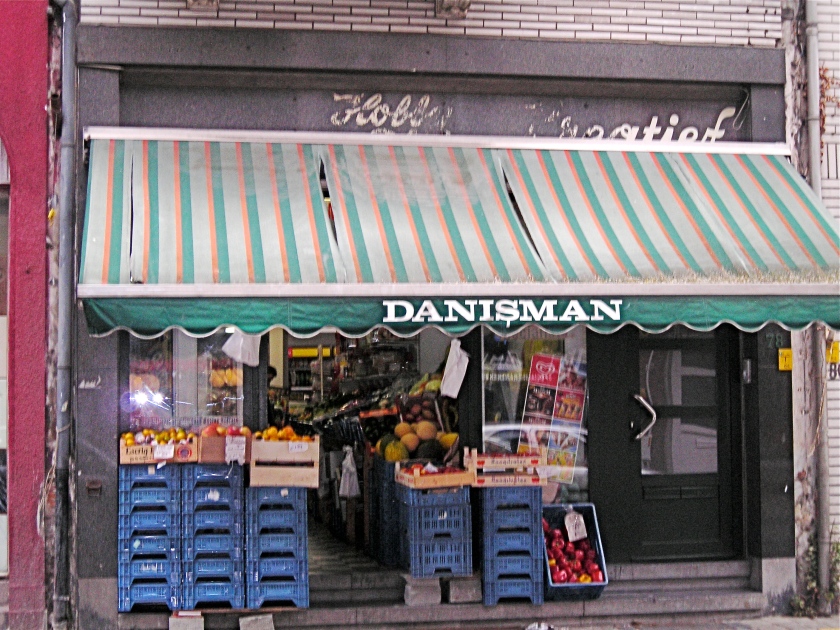
5.8 The Gujarati grocery

Jan Blommaert 

The very first issue of a new academic journal called Linguistic Landscape (vol 1/1-2, 2015, John Benjamins), unsurprisingly devoted to Linguistic Landscape Studies (LLS), contains much to be concerned about. I happen to be a member of the editorial board of that journal (but was not consulted during the preparation of that first issue), and what follows should best be seen as a friendly and collegial encouragement to seek improvement in work done in an emerging and potentially highly dynamic and productive field. At the same time, as we shall see, my comments are not entirely disinterested; part of what I have to say is about my own work and how it relates to what is presented there.

My main cause for concern is that the first issue of Linguistic Landscape presents the field of LLS as precisely the opposite of what I just wrote: it suggests an established, mature and fully developed field of scholarship – a tradition if you wish – for which a methodological “canon” can be proposed, to be emulated in future work. Future work, then, can and might be judged as either “in” the tradition, as “canonical” work, or conversely as a departure from it, a rupture, a deviation. Several papers in the first issue explicitly position the kind of Ethnographic Linguistic Landscape Analysis (ELLA) developed by myself and my colleagues in the latter sense, as a deviation (e.g. Blommaert 2013; Blommaert & Maly 2015).

The development of ELLA – to sketch my own point of view – was an attempt to do more with LLS than what was done in the “first wave” of studies (see the references in Blommaert & Maly (2015); and pp.2-3 in the same source where I sketch, conditionally, the genuine potential of LLS). This first wave, I insist, was marked by a synchronic, static and quantitative approach to hypostatized “languages” in a given physical arena. Old-skool multilingualism-in-space, so to speak, in which “languages” – their presence as visual markers – were a priori seen as indicators not just of present populations (of “speakers”) but also of regimes of multilingualism, readable from the relative (quantitative) preponderance of language A over languages B, C, … n in a given space. The critique of this general (and widespread) theoretical stream has been abundant and is ancient by now; I need not reiterate it.

Against this approach, we pitted an ethnographic approach, in which signs are seen as traces of multimodal communicative practices within a sociopolitically structured field which is historically configured. Note, for clarity’s sake, three major points here:

  • Ethnography is intrinsically historicizing, because any form of effectively performed (and ethnographically monitored) communicative practice can only be made meaningful because of its (Bakhtinian) histories of production and uptake by nonrandomly positioned actors. Contrary to what is widely assumed, ethnographic research is the exact opposite of synchronic, snapshot-based inquiry. I have belabored this point extensively in a long stream of publications; one can check chapter 6 of Blommaert (2005), chapter 5 of Blommaert (2010) and the entire Grassroots Literacy book (2008) for clarification.
  • The theoretical backbone for the first point can be found in the neo-Whorfian, Hymesian and Silversteinian tradition of linguistic anthropology – not elsewhere, for its roots (like those of any intellectual enterprise) are not accidental nor freely exchangeable. What was said above about the meaningfulness of the sign is an exact empirical reformulation of that central concept in this tradition: indexicality. Failing to grasp that point, and its theoretical implications, renders dialogue about it rather pointless.
  • In addition, the effort is driven by an ethnographic understanding of social “structure” as dynamic, fragmented and essentially stochastic, i.e. “chaotic”: while the general vector of change can be determined, the actual outcomes of processes of change are relatively unpredictable, even if they appear “logical” post factum. Random aggregates of processes generate nonrandom outcomes, and change is the “system” we observe. Note that this is a departure from established Durkheimian-Parsonian understandings of “structure” as that which dominates the “large” (“macro”) processes in social life and does so in an enduring way. Practically speaking: “structure” can reside in the exceptional, the near-invisible, rather than in the dominant. The politics of a place is not readable in a self-evident way from the volumes of particular signs displayed in that place.

Those fundamental theoretical choices explain why, in ELLA, the work of political-historically astute scholars such as Gunther Kress or Adam Jaworski, and ethnographically sophisticated ones such as the Scollons, takes pride of place. It does not warrant too much explanation that these choices are ontological, methodological as well as epistemological. As for the latter: we assume that LLS, thus performed, might bring something unique and valuable to higher levels of generalization about societies, their histories, dynamics and structures.

0000

Let me now sketch the way in which LLS is imagined as a tradition in the first issue of Linguistic Landscape. This is done in the opening position paper by Monica Barni and Carla Bagna, “The critical turn in LL: New methodologies and new items in LL”. The point is quickly summarized. Barni and Bagna observe that since its inception by Landry and Bourhiss in the 1990s, LLS has seen an expansion, both in foci of interest – different spaces, different types of signs, different forms of multilingualism – and in methodological orientations. As for the latter, they welcome the “interdisciplinary” expansion of LLS which now comprises – to name just a few – linguistic, sociolinguistic, sociological, political-analytical and semiotic approaches. And this, they emphasize in a somewhat puzzling turn of argument, is in itself an “innate critical turn” – even if the question as to what this turn would precisely be critical of remains, intriguingly, unanswered. It is interesting that no mention is made of ELLA in the review provided by Barni & Bagna of this critical-turn-through-expansion, in spite of the explicitly critical intentions behind ELLA I described earlier.

This expansion of the field of LLS is also seen, in itself, as a firm refutation of the criticism leveled in Blommaert & Maly (2015) against the general trend of the “first wave”, summarized above. For in the conclusions to the paper, suddenly our comments emerge, albeit in a curiously truncated form. And they are rejected as follows:

“The studies mentioned in the above paragraphs (and many others that could not be mentioned for reasons of space), contrary to the assertion by Blommaert & Maly, demonstrate that once LL was identified as a field of analysis, a number of perspectives opened up immediately. These made it clear above all that studying the LL does not mean limiting oneself to counting the languages present in it, but involves contextualizing the analysis, broadening it to encompass the actors who shape or use the landscape and the factors which have contributed to its formation over time (…). In addition, different investigative methodologies need to be used depending on the research objectives.”

No mention is made of our main point of criticism: the absence of an ethnographic-historical approach which uses sociolinguistic objects as an infinitely sensitive tool to detect sociopolitical change at levels and in sites usually not judged relevant. Or to put it differently: the surrender of all ambitions to say something substantial about society in ways not ususally done by sociologists, anthropologists, historiographers or political scientists, in favor of a preference to stick within a safe, “canonized” synchrony grounded in a kind of instant sociology of the most conventional kind – to reiterate Glyn Williams’ (1992) now classic critique of mainstream (Fishmanian) sociolinguistics. Obviously, the ontological, methodological and epistemological dimensions of our critique remain unadressed, and I see no reason to consider them refuted to any degree. Barni and Bagna seem to believe that saying that certain options are not being taken (or even worse, wishing that they were not being taken) equals effectively not taking them. It is to be hoped that Linguistic Landscape does not take this intellectual effortlessness as its guideline.

0000

The issue, to be fair, does make an attempt towards scoping the expanding field of LLS as described by Barni and Bagna. There are admirable papers by, for instance, Adam Jaworski, David Malinowski and Amiena Peck & Christopher Stroud. All three of these papers are genuinely explorative, even idiosyncratic (which I welcome), and show the creative use of LLS techniques deployed in atypical fields. Jaworski’s analysis of art in public spaces, for instance, offers a welcome broadening of the objects of LLS from strictly linguistic to more broadly semiotic ones, and directs us towards a sociosemiotics of public space not constrained by questions of multilingualism. Peck and Stroud, by focusing on “skinscapes”, expose the simple but often overlooked fact that linguistic landscapes also, usually, include people moving through them, and that the bodies of these people are equally “readable” within such landscapes. And Malinowski’s study emphasizes the value of linguistic landscapes as important learning environments, adding a superb potential for application to the fundamental-scientific interest of LLS.

But the paper by Barni and Bagna is immediately followed by a paper by Eliezer Ben-Rafael and Miriam Ben-Rafael, “Linguistic landscapes in an era of multiple globalizations”. And this paper does exactly what we took issue with in our critique of “first wave” LLS. Ben-Rafael & Ben-Rafael compare three cities: Brussels, Berlin and Tel-Aviv. They count languages as occurring in public space there and focus on the quantitatively dominant ones as the ones informing us of “structural” aspects of the place (in the Lévi-Straussian sense, according to the authors, so fortunately not in any realistic sense). This quantitative, sociologically baffling approach is couched in the most superficial snapshot-analytical “background” on these three cities (and the actual sites of research therein).(1) And this mixture is next presented as something that should yield fundamental and insightful facts about the social effects of globalization.

Here, once more, we see how LLS practitioners believe that change can be analyzed by looking at everything that does not index it, in ways that preclude any advanced understanding of its dynamics. If the presence of this paper in the launching issue of Linguistic Landscape is to be understood in a programmatic sense, as an announcement of more to follow, it means, sadly, that the “first wave” of LLS will never really end.

It gets worse. In a truly perplexing text, Aneta Pavlenko and Alex Mullen discuss “Why diachronicity matters in the study of linguistic landscapes”. I would of course nod approvingly, given my own take on the intrinsic historicity of any form of actually performed language and the amount of argument I brought to this precise issue. But Pavlenko and Mullen take exactly my work as an example of anti-historical argumentation in the field of LLS and beyond. Pavlenko also takes issue, elsewhere, with the way in which Ben Rampton and myself discuss superdiversity – e.g. Blommaert & Rampton (2011) – but manages to overlook, in the exercise, the rather fundamental fact that we see the role of the internet as crucially defining superdiversity as a historical moment. (I shall return to this issue shortly.) This obvious and elementary misrepresentation is repeated in the paper discussed here.(2)

I shall be forgiven for being a wee bit impatient in the face of a facile critique based on an avoidance of almost everything I have said on the topic. One can disagree about something, but that something needs to be precisely and fully represented; if not, one finds oneself facing a straw-man argument of dubious intentions and no weight. I shall therefore focus, instead, on how this argument operates in the general concept of the launching issue of Linguistic Landscape. And I can be brief.

Pavlenko and Mullen discuss linguistic landscapes from classical antiquity, with forms of language now often called “languaging”, as “proof” of the fact that superdiversity must have occurred in ancient history and that, consequently, contemporary claims about the newness of the phenomena of sociolinguistic superdiversity by people such as yours truly are grossly overstated. They commit three substantial errors while building their case.

  • One: they base their argument on a surface-formal inspection of linguistic forms and disregard the sociolinguistic conditions under which such forms operate. While I, and others, have repeatedly and elaborately explained that not the forms of language – complex patterns of mixing and new forms of creolization, for instance (see e.g. Rampton & Sharma 2011) – are “new” or “unique”, but the sociolinguistic conditions under which they emerge, are distributed, and acquire sociopolitical value in social life (see e.g. Blommaert 2015). Pavlenko and Mullen’s assumption, thus, is that linguistic similarity equals sociolinguistic similarity, which is a simple denial of most of what sociolinguistics has been trying to establish over the past six decades.
  • Two: Extrapolating from the first error, they assume unbroken historical continuity indexed through similarities of forms of language across time. Similarities in traces of communicative patterns over time would, absurdly, suggest similarities in social systems over centuries. I am eagerly awaiting evidence for that assumption.
  • Three, they define history as diachrony – a very widespread error in our fields of study, and the topic of several of the critical writings of mine I mentioned earlier. Time itself is not the stuff of history: it is time filled with human social agency; this simple statement defines modern history as a science. It is the reduction of history to diachronic comparison that leads so often to that classic antihistorical error called post hoc propter ergo hoc: when we see things “reoccur”, they must be related to their “previous” occurrence. There is nothing interesting in diachronic analysis other than the fact that it raises historical questions, not answers them.

To the extent that this paper should represent the “historical branch” of LLS in the expanding scenery scoped by Barni and Bagna in this launching issue, the message is disconcerting, for it suggests that superficial formal diachronic comparison equals historical LLS research. So doing, it re-emphasizes precisely what used to make much of so-called historical-comparative linguistics so useless and misleading for scholars of the history of societies. On this issue too, there is a rich critical literature which appears to be entirely overlooked (e.g. Irvine 2001).

As to the way in which ELLA is used to make this point: the paper by Pavlenko and Mullen should add to the “refutation” by Barni and Bagna of what ELLA claims to contribute to LLS. And both fail in their attempt. It is regrettable that ELLA, as a genuinely constructive (and critical, to be sure) attempt to “expand” LLS, is discussed in such a deeply cavalier and intellectually compromising way in this issue.

0000

The straw man built by Pavlenko and Mullen, as we have seen, revolves around a reduction of what people such as I have to say on superdiversity to just migration patterns in physical space. While our argument (and the point at which we fundamentally deviate from, for instance, Steve Vertovec’s view) has always been that it is the confluence between such new migration patterns and the presence of new technologies for communication and knowledge distribution, that has shaped a fundamentally new sociolinguistic environment. And this brings me to a final observation.

The internet is the largest and most complex social space on earth now. It is a profoundly multimodal space which engages hundreds of millions of individuals in communicative practices that did not exist before the 1990s and have entirely reordered what we understand by “repertoires”, “knowledge of language” and “language usage”. It also reshuffles the empirical character of what is public and what is space (or better: timespace) in ways that not just invite but demand profound theoretical re-imaginations – paradigm shifts, if you wish. There is nothing “virtual” to the internet – this very text on my blog is as real, as effective, and as published, as any traditional hard-copy journal article or book. In spite of all that, the “virtual” is either avoided in mainstream research or segregated into some specialized “e-studies” niche of scientific practice.

This is unfortunate, for the challenges offered by the historical transformation of the infrastructure for social interaction and community formation are general and inevitable. It is this awareness that underlies my sociolinguistic work, for the present episode of globalization cannot in any way be understood without a profound and integrated engagement with the electronic knowledge-and-communication engines that are intrinsic to it and exert a systemic influence. And it is precisely because of the fact that this historically unprecedented change in infrastructure happens to be a communicative thing, that our fields of study may have a bit of an edge over others: no one can accurately comprehend the contemporary world without comprehending the new complex communicative modes and economies it generates.

Not a single paper in the launching issue of Linguistic Landscape presents research on the “scapes” we see on the internet. Signs in public space – the object of LLS – are conservatively, even stereotypically, defined as hard-copy signs in physical “offline” space, within clearly demarcated timespace configurations. I do not see an unlimited potential for theoretical and methodological expansion in that conventional domain, but I do see such potential when we also consider signs in the “virtual” public arenas in which all of us are presently profoundly socialized, and in which we spend large chunks of our lives these days. It is the way in which the new modes of communication merge and interact with old ones, and so reshape existing communicative economies at all levels of social life and from metropoles to margins in the world, that should concern us.(3)

The innate critical potential of LLS, I would suggest, needs to be searched there. For I repeat what I just said: we cannot understand contemporary society by dismissing its historically unique infrastructure as an elementary area of inquiry.

Notes

  1. One example. The authors announce that they included, in their Brussels study, the linguistic landscapes of the “Flemish quarter” of Linkebeek. First, Linkebeek is not part of Brussels, but that is a detail. More interestingly, Linkebeek is administratively Flemish but cannot in any way be seen as a “Flemish-speaking” area, as its population is overwhelmingly, and even politically militant, Francophone. In fact, one of the typically nagging Belgian political issues of the past few years is the appointment of a Mayor in Linkebeek. By law, the Mayor should use Dutch as the working language, but the Linkebeek population elected by a landslide (and later, emphatically re-elected) an uncompromising Francophone politician as its Mayor, leading to the refusal of his confirmation by the Flemish government, and so on and so forth. It’s not a new thing: as a teenager growing up in Brussels in the 1970s, I attended numerous rallies protesting the “Frenchification” of Linkebeek. C’est la Belgique: an administrative identification problematically imposed upon a different demographic identification. So rather than “Flemish”, it would be safer to call Linkebeek “superdiverse”.
  2. See for an example of this misrepresentation:  https://www.academia.edu/21163221/Superdiversity_and_why_it_isnt_Reflections_on_terminological_innovation_and_academic_branding. Note that the paper by Pavlenko and Mullen is a revised version of a paper delivered at a workshop on “Linguistic Landscapes Ancient and Modern” held at All Souls College, Oxford University in the Summer of 2014, where I was present. I discussed these issues with the authors on that occasion. For an elaborate response to similar misrepresentations, see https://alternative-democracy-research.org/2016/02/10/sociolinguistic-superdiversity-under-construction-a-response-to-stephen-may/
  3. For an example of analysis in which the offline LL world of graffiti is connected to its online infrastructures, see https://alternative-democracy-research.org/2016/01/11/760/

Postscript, June 2016

I’m very happy to add that the subsequent issues of the journal are significantly better.

Links and references

The first issue of Linguistic Landscape:  https://benjamins.com/#catalog/journals/ll.1.1-2/toc

Blommaert, Jan (2005) Discourse: A Critical Introduction. Cambridge: Cambridge University Press.

Blommaert, Jan (2008) Grassroots Literacy: Writing, Identity and Voice in Central Africa. London: Routledge

Blommaert, Jan (2010) The Sociolinguistics of Globalization. Cambridge: Cambridge University Press.

Blommaert, Jan (2013) Ethnography, Superdiversity and Linguistic Landscapes: Chronicles of Complexity. Bristol: Multilingual Matters.

Blommaert, Jan (2015) Commentary: Superdiversity old and new. Language & Communication 44: 82-88

Blommaert, Jan & Ico Maly (2015) Ethnographic Linguistic Landscape Analysis and social change: A case study. Tilburg Papers in Culture Studies 100. https://www.tilburguniversity.edu/upload/6b650494-3bf9-4dd9-904a-5331a0bcf35b_TPCS_100_Blommaert-Maly.pdf

Blommaert, Jan & Ben Rampton (2011) Language and superdiversity. Diversities 13/2: 1-22.

Irvine, Judith (2001) The family romance of colonial linguistics: Gender and family in nineteenth-century representations of African languages. In S. Gal and K.Woolard (eds.) Languages and Publics: The Making of Authority: 30-45. Manchester: StJerome.

Rampton, Ben & Devyani Sharma (2011) Lectal focusing in interaction: A new methodology for the study of superdiverse speech. Working Papers in Urban Language and Literacies 79. https://www.academia.edu/6356342/WP79_Sharma_and_Rampton_2011._Lectal_focusing_in_interaction_A_new_methodology_for_the_study_of_superdiverse_speech

Williams, Glyn (1992) Sociolinguistics: A Sociological Critique. London: Routledge.

by-nc

Teaching the language that makes one happy

bfcfb17f8512cbe63c85d9448e6c8b91

Jan Blommaert 

During my time at the London Institute of Education (2005-7), I was deployed in the TESOL section and worked with an outspokenly international group of students. These students were recruited after a rigorous selection in which superior IELTS scores were mandatory. All were, consequently, “fluent” in “English” when they arrived in London. The scare quotes around both terms above will become clear as we go on. For the thing is: all of these young people were highly skilled globalized junior academics, but many of them were unhappy in London.

I talked to a great many of them and started making observation notes on their English conversational proficiency. I also asked them how they felt about their English proficiency, and when one of them replied “I can’t understand their [i.e. UK English] jokes and that frustrates me”, my curiosity was triggered. I started talking to them on the specific bit of English they felt they lacked in London. The answers were highly diverse, but some stood out. One recurrent answer was: I don’t have the English that can help me find a boyfriend/girlfriend – the English one needs to flirt and enter into a love relationship with someone. Another was: I don’t have the English I need to understand entertainment shows on British TV. And yet another: when I go out for drinks with British friends, I just can’t understand a lot of what they’re saying in the pub. Many articulated frustrations about the fact that their limited English proficiency made it very difficult for them to come across as an interesting, witty, creative and nice person. Many felt socially awkward and lonely, and had the impression that making real friends was terribly hard, given the constraints they experienced in informal social interaction with others.

Their responses reminded me of my own experience teaching and living in Chicago in the Winter of 2003. From 9 to 5, I would be talking shop there, and interlocutors would have perceived me as highly articulate and confident, perhaps even eloquent in English. As soon as I left the UofC campus and went shopping, however, I felt I was lacking almost all of the English I needed to identify the right meat cuts, vegetables or cleaning products. And one of my most catastrophic communicative experiences was when I had to call a plumber about a drainage problem in my bathroom: I lacked literally every bit of English required to adequately explain the problem and was reduced to begging the plumber to come over and see for himself. On campus, I was a “near-native” user of English, while in the supermarket or with the plumber I must have sounded like just another immigrant struggling with basic English vocabulary.

Such anecdotes are relevant for at least three reasons.

  1. They show us that “language learning” is effectively register learning. My students and myself had acquired the academic register characterizing contemporary globalized academic practices and culture; we had not, au contraire, acquired the registers that controlled specific informal social and cultural communication modes, and could consequently not perform the roles we were supposed to play in and through them.
  2. In the case of my students, they also show that “language” testing is in actual fact register testing: high IELTS scores indicate a high level of active and passive proficiency in a limited set of registers and genres qualified with a  (rather unhelpful) umbrella term as Academic English. They do not indicate a general socioculturally adequate competence in English, and do not as such announce a generative or cumulative competence. That is: having achieved high levels of academic register-genre proficiency does not automatically generate (or even facilitate) competences outside the domains covered by such registers and genres; such specific register-genre competences must be learned separately.
  3. And most importantly, they show us a thing or two about integration. Let me elaborate that latter point.

There is, in the context of migration and superdiversity, a policy response which is widespread across Europe (and further afield) in which language learning is proposed as the key to “integration”. The latter is a word in search of a clear definition (and has been for decades), but in actual practice, it is usually paraphrased as “participation in social life”, with some emphasis on facilitating entrance into the labor market. Observe that “integration” is usually presented as one single process in which someone presently “not part of society” will become part of that society by a unilateral effort of adaptation, in which language learning is crucial since – one frequently reads – one cannot participate in the life of a community without communicating with other members.

What we now know is that

  • Integration is not a single process but a multiple one, in which several very different forms of “integration” need to be achieved, into numerous specific social milieux and niches, each organized and characterized by their own sociocultural normative codes, in order to be, let us say, happy as a social and cultural being.
  • Integration into the “most important” social milieu – academic work in the case of my students, the labor market in the eyes of many policy makers – does not guarantee integration into the different milieux and niches that make up social life outside the “most important” segment of it. As my own experience showed, one can be highly integrated in the segment of labor and the sociocultural milieu that sustains it, and poorly integrated (even highly marginal) in several other social milieux. In fact, this assemblage of different degrees of “integration” in which one is simultaneously very well integrated in some segments of sociocultural life, less integrated in some others and not integrated at all in another set of them – is perhaps the default mode of “integration” any person would have in social life in general, at any point of time.
  • Consequently, teaching competences and skills deemed useful for “integration” would seem to require a very precise diagnostic stage in which the specific register-genre needs valid for targeted social milieux (and thus defining a range of very different integration processescan be identified and followed up by more precise and specific knowledge transfer.

Being “fully integrated” as a person, when one investigates it in some detail, actually refers to a set of experiences of satisfaction – happiness, let us say – derived from a perceived smoothness in social contact beyond the borders of narrowly conceived and functionally defined social milieux such as that of labor. It actually means that one is integrated into the full set of social milieux experienced as crucial for a satisfying social life. When we teach people the language they need for this purpose, we have to teach them the specific bits of language that make them happy. The term “happy” sounds funny, perhaps, and there is no tradition in language teaching where it has ever been central. I suggest we take it very seriously.

by-nc

The weakness of surveillance

151116115255-paris-attackers-salah-abdeslam-super-169

Jan Blommaert 

After the attacks at Charlie Hebdo in Paris, January 2015, security was tightened all over Europe. It was announced that the security and intelligence agencies of the member states would intensify their collaboration, specifically in the domain of data compatibility and exchange, in an attempt to tighten security to such an extent that new terrorist attacks would become impossible – intelligence would ensure that plans would be known long ahead of the moment they were planned to be executed.

Evidently, the Paris attacks on Friday 13th of November 2015 demonstrated the opposite. A relatively large group of terrorists infiltrated Paris in a coordinated shoot-out, bombing and hostage operation causing death and injuries to a large random group of victims.

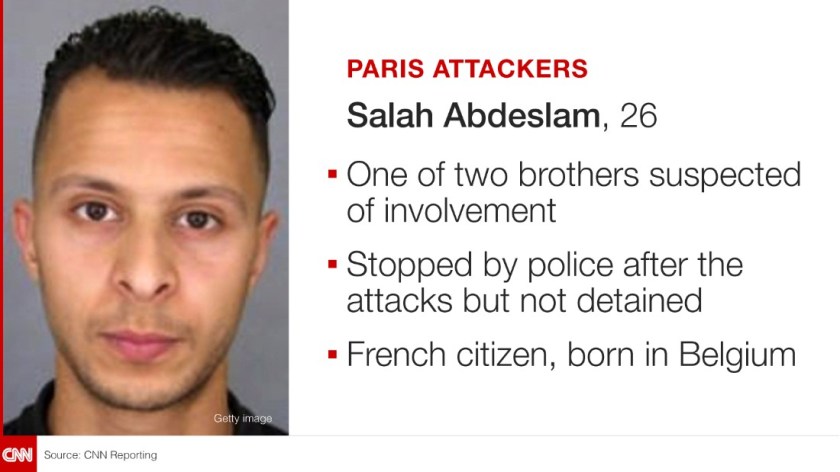
What is more, the surviving terrorists escaped. One member of the terrorist team – Salah Abdeslam – made his way back across a heavily patrolled border into Belgium; his car was stopped but he was not recognized by the patrolling police officers. In the days that followed, Belgian security and intelligence forces believed that he was hiding in the Brussels district of Molenbeek. The Belgian government declared the highest level of terror alert, and an enormous police action in Molenbeek was launched on 22 November. Armed soldiers patrolled the streets of Brussels (and were deployed in other cities as well), the Brussels Metro was closed, and schools would remain closed until further notice.

The massive raid of 22 November didn’t yield any results. A large handful of people were arrested, but all but one of them were released the next day. No weapons, bombs or other terrorist equipment were found. And, humiliatingly, Abdeslam was not captured. He had escaped. When he was eventually captured, four months later in March 2016, he was found in a house almost adjacent to the one raided in November 2015. And a few days after his widely publicized arrest – “we got him!!”, yelled our Ministers – several bomb attacks devastated Brussels Airport and the Brussels Metro, killing dozens of citizens.

The surveillance structure now put in place, in which the privacy of all citizens is sacrificed to the priorities of a safe public space, and in which all communication traffic is stored as “data” enabling security forces to achieve an unprecedented level of accuracy in identifying possible and effective criminals, to anticipate their plans and to locate their whereabouts – this structure appears to have failed, both in Paris and in Molenbeek, and probably in every other search currently being conducted across Europe. It has failed systematically throughout the entire episode.

The reason for this is quite simple for those who are interested in human behavior: the focus on electronic systems of communication narrows human behavior to just a segment of what we do, believing that this segment suffices to capture the totality of behavior. Empirically, we now see, this assumption is wrong. Abdeslam and his colleagues, at several points in the past months, operated outside of the structures of electronic surveillance, and they did so in a way that kept them adequately informed and alert to the moves of the security forces. Talking face-to-face, or through a network of face-to-face relays, for instance, still exists as a mode of communication, and it cannot possibly be traced by surveillance systems.

Increasing the capacity of this surveillance system will not, for reasons too clear to warrant much explanation, improve its accuracy. It will still cover just a fraction of the social environment in which real people deploy real social behavior and leave the rest unchecked. While, in return, the privacy of an entire population has been surrendered, and might be invaded whenever – for reasons never disclosed to the target – one becomes a “suspect” in the eyes of the surveillance operators.

There is a tendency, when people become desperate, to do more of the same but do it harder, faster and more intensive. In the field of security, the failure of the present system of surveillance should result in a profound revision of its assumptions and methodology. Because while it is definitely totalitarian in scope and pervasiveness, it does not offer total security. In fact, whenever it has to live up to its promises, it appears to fail miserably. It is time to recognize this failure.

by-nc

A Historic Night for the American Anthropological Association

anthroboycott's avatarARCHIVED: Anthropologists for the Boycott of Israeli Academic Institutions, 2014 - 2016 Campaign

[click here for a Storify of tweets and photographs from the meeting]

On Friday evening in Denver, the American Anthropological Association (AAA) endorsed the Palestinian civil society call to boycott Israeli academic institutions by over 88% in the most well-attended business meeting in the association’s history. The measure will now be forwarded to the entire membership for a final vote by electronic ballot in the spring.

As heirs to a long tradition of scholarship on colonialism, anthropologists affirm, through this resolution, that the core problem is Israel’s maintenance of a settler colonial regime based on Jewish supremacy and Palestinian dispossession backed by the U.S. government. By supporting the boycott, anthropologists are taking a stand for justice through action in solidarity with Palestinians. The AAA is the largest scholarly association yet to endorse the boycott of Israeli academic institutions at an annual meeting.

What follows is a detailed account of that historic night…

View original post 1,918 more words

Seeing double? How the EU miscounts migrants arriving at its borders

Nando Sigona's avatarPostcards from ...

Nando Sigona, University of Birmingham

Frontex, the border agency charged with European external border management, has released data claiming 710,000 migrants entered the EU between January and September this year.

According to the agency, this represents an “unprecedented inflow of people”, offering as a comparison data from last year, when 282,000 entries were recorded in total.

I found out about the data release via Twitter. Alarms bells immediately rang.

//platform.twitter.com/widgets.js

The numbers thrown out by Frontex are not only a noticeable increase on 2014 figures. They are also significantly higher than data published recently by the UN and the International Organization for Migration on the number of people entering the EU irregularly by the sea. These showed 590,000 estimated arrivals.

These figures are immensely important. They have a profound impact on the public debate about the refugee and migration crisis. They are quickly picked up by the…

View original post 551 more words

One crisis, three photos: how Europe started caring for refugees

11855660_1179347732081755_1541023282886164069_n

Jan Blommaert 

Bayern München, one of Europe’s greatest and most distinguished football clubs, today announced that it will donate one million Euro to initiatives assisting refugees with shelter and support.

The news hardly makes headlines, in spite of the fact that it is actually quite spectacular. Organizations such as Bayern München are not normally known for generosity towards people other than their players, VIPs and sponsors; the fact that they now jump the bandwagon of grassroots support for (mostly) Syrian refugees tells us that it is, indeed, quite a bandwagon. And that bandwagon races ahead at an amazing speed and carries a rapidly increasing volume of cargo, in spite of European governments’ overwhelmingly discouraging response to calls for increased support and empathy towards those who seek refuge within the safe boundaries of the Union.

***

Undoubtedly, historians will later write about the summer of 2015 as a moment in which the EU all but completely lost control over its own public image. The summer started with the brutal suppression of whatever attempt towards regaining sovereignty and democracy was made by the Syriza government of Greece. The results of a referendum were brushed aside without much ado, and barking “austerity!!” became the default mode of communication of the European institutions towards anyone raising even mildly critical questions about it. The EU emerged from the Greek budget conflicts bruised and scarred but with a stiff upper lip; large segments of the European population, in the meantime, had turned their backs on the EU, and probably forever.

Greece was equally the scenery for the second wave of extraordinarily damaging events for the EU when hundreds of small and unstable boats, packed with refugees from the crisis areas in the Middle East, started arriving on the shores of the Greek Islands in the Aegean, often in dramatic conditions. I should be more precise, though. The damage to the EU, and to individual member states’ governments, was done when images of such arrivals were splashed on the front pages of almost any medium in the world.

The “refugee crisis” (as it is now dubbed) started in April 2015. Sure, there were boat refugees prior to that date (Lampedusa, recall), but when hundreds of dead bodies (including those of women and children) were discovered by patrolling ships in the Mediterranean in mid-April, Pandora’s Box was opened. The EU’s “Mare Nostrum” policy was instantly blamed for this tragedy – a repressive policy of “keeping immigrants out” as part of what is now dubbed “Fort Europe”. The outcry was tremendous, and the EU leadership rapidly changed tactics, sending navy vessels on search-and-rescue missions and bringing, thus, thousands of refugees safely ashore. The “refugee crisis” started as soon as the ideological angle of debates on immigration shifted from the immigrants themselves to the political institutions refusing assistance or support to them. Until then, and for a couple of decades already, the political consensus (and its propaganda, of course) had defined immigrants in negative terms, as “adventurers” and “fortune seekers” who have no good cause to seek asylum in the EU and were basically here to take advantage of the wealth accumulated by hard-working EU citizens. Since good numbers of immigrants were Muslims, suggestions of terrorist “fifth column” threats were whispered, and the heavy metal of moralizing condemnation of such “irresponsible” people by European politicians blasted through every TV and radio speaker. A very large chorus of journalists, opinion makers and citizens on social media joined in.

From mid-April 2015, the tone changed entirely. And the cause of that change was visual. The bandwagon started rolling as soon as extraordinarily sad and painful pictures appeared from refugees who did not look like the “adventurers” of European anti-immigrant propaganda. They looked like innocent victims, and the visual confrontation with such “real” refugees was what caused an opinion shift in favor of supporting refugees, and increasingly critical of governments’ stubborn refusal to do so. The burden of “guilt” for what happened thus shifted from the shoulders of the immigrants towards those of governments who had been busy designing repressive anti-immigration policies and had, while doing so, also neglected the administrative and material infrastructures required for offering support to those who applied for it under the terms of international conventions. The real “crisis”, in that sense, became less a crisis of huge numbers of people entering the Union, than a crisis of the perplexing inadequacy of the systems necessary to cope with such numbers. The crisis became political.

***

Before taking this argument further, a general point is in order. We live in a media-saturated society in which the supply of graphic images is virtually unlimited, certainly in an information market in which traditional mass media are complemented by vast volumes of social media broadcasting, in which citizen journalism, crowd-sourced information and virality are rapidly changing the rules of classical mass media propaganda. When Herman and Chomsky wrote their “Manufacturing Consent” (1988), they described a world in which the Murdoch empire could make or break governments as long as one applied the rules of propaganda. This propaganda model is in need of drastic revision at present: sure, Mr. Murdoch can still make or break governments, but he must keep track of a broad range of unpredictable (and uncontrollable) forces – true “mass (social) media” not within his control. The “light” communities of the social media age are still not taken too seriously by analysts of power and social structure; that is to their own peril, because we are seeing with increasing frequency and intensity how such “light” communities start behaving very much like the “thick” communities of classical social and political analysis. They abandon the quick-and-easy “clicktivism” often ascribed to them, move offline, get organized and start citizen movements and action groups, engage in new forms of economic transaction, and win elections.

Politics, in that sense, has become considerably less predictable, for the rules of public opinion formation have been pluralized and dispersed over vastly more voices and actors, many of whom cannot be brought under control that easily. What happens to the EU now, consequently, came as a surprise to many of its leading politicians – the summer months are traditionally a period of political insignificance, in which the media and their publics get upset about trivial things. In 2015, if politicians switched off their monitoring tools in June and switched them back on in September, they found themselves in an almost unrecognizable world.

***

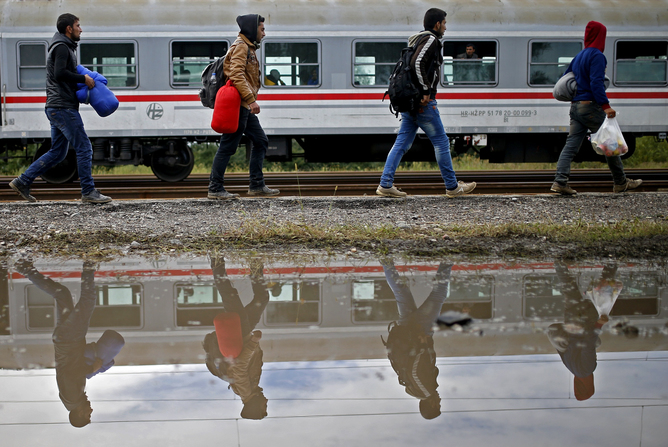
I must get back to the images that triggered that change. The refugee crisis of mid-2915 was documented by means of millions of pictures, several of which caused considerable impact. There were shocking pictures, of course, of the drowned victims floating in the Mediterranean; of refugees trying to enter the Channel Tunnel in Calais; of refugees storming trains in Macedonia and Hungary; of seventy-odd dead bodies of refugees in a truck somewhere in Austria; of police brutalities committed against refugees; of makeshift or formal “concentration” camps for refugees, and of barbed-wire fences being raised along the borders of countries so as to keep the immigrants out.

Of these millions of images, however, three specific ones have made a massive impact – they went viral, were shared millions of times on social media platforms, and triggered avalanches of angry and committed commentary both in mass and social media. There is little intrinsically exceptional to the pictures themselves – those who have followed reporting over the summer have seen better and worse ones, to be sure. Semiotically, the sequence of three photos represents an escalation from bad to worse, but that is all. So the question as to why these specific pictures were “chosen”, so to speak, to become the emblematic ones punctuating the rhythm of mass grassroots mobilization among EU citizens cannot be answered by merely looking at them or by dissecting the semiotic structures they represent. There is a greater randomness to the actual image than to its context – if we wish to understand the impact of these pictures, it is the context that should concern us, and it is the context that I shall try to address in a moment. Let us first consider the three iconic images of the “refugee crisis” of the summer of 2015.

The first picture started circulating towards the end of April 2015. We see a confused scene on a Greek island in the Aegean in which a woman is dragged out of the sea onto the cliffs by a man. The man is a Greek citizen, and the woman an Eritrean refugee, whose boat had crashed into the cliffs just minutes earlier. The woman was pregnant and gave birth shortly afterwards.

6XzEut7UEHSK2-3052791-Wegasi_Nebiat_was_rescued_from_a_shipwreck_when_the_smuggler_boa-m-31_1429814548610

This image was widely shared and intensely commented and discussed; the protagonists were interviewed and became modest celebrities for a short while. The supposed “danger” of immigration was here represented by a pregnant woman from Africa – not someone who corresponds to the propaganda stereotype of the young masculine fortune seeker, but a person embodying extreme vulnerability. The woman is a victim, not a perpetrator, and her face tells a terrifying story. Saving someone in that situation from an almost certain death is morally unchallengeable: it is something good, something we all have a duty to. Discussions on social media fora, consequently, quickly struck an outspokenly moral tone: the refugee crisis had become a question of good versus evil, and if governments remained hesitant or reluctant to welcome such people, the governments were a rotten bunch.

The impact of this picture was considerable for a while, until the headlines gradually started focusing on the Greek Syriza-Trojka drama which occupied most of public opinion in June and July. But then the second photo started circulating.

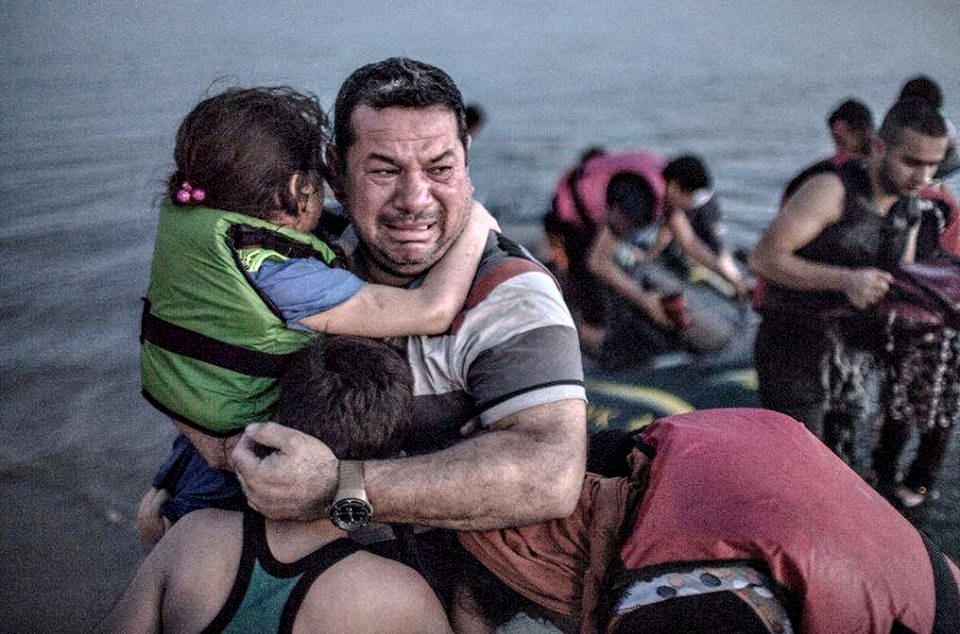
The second picture appeared in August; the scene and setting are almost identical to the first one. We again get a “landing” scene, of refugees on the rough shores of a Greek island, at dawn. An adult man, crying, holds a child in his arms and hugs another, while victims and rescue workers fill the background.

foto 2

This picture suggests a parent-child frame: a father in deep distress holding that radically vulnerable type of human in his arms – his children. Again, these are victims, and it is impossible to read anything else into this image. It is equally impossible not to imagine, and sympathize with, the misery experienced by the man, or his emotion at the moment he knows that his children are safe and alive. As a footnote we can add here that, semiotically, children connect the three photos – from a pregnant woman to a father with his kids, and soon towards the lone child: there is a line. But this is a footnote.

This picture went viral; memes were developed on the basis of this image, and it circulated with angry captions directed at the insensitivity and incompetence of governments turning such innocent people away from their borders. The picture revived the theme of refugees after some weeks of relative quiet, and it circulated in an expanded range of audiences. Its mobilizing force was obvious, and citizen movements started forming in several places in the EU.

In the first days of September, the third picture was released and hit the public like a nuclear bomb. That radically vulnerable type of human being, a child, was still alive and with his father in the second photo. In the third one it is dead and abandoned, lying as if asleep on a beach near Bodrum in Turkey, fully dressed and very, very small. If ever there was an image of an innocent victim, this is it.

ScreenHunter_409 Sep. 04 16.53

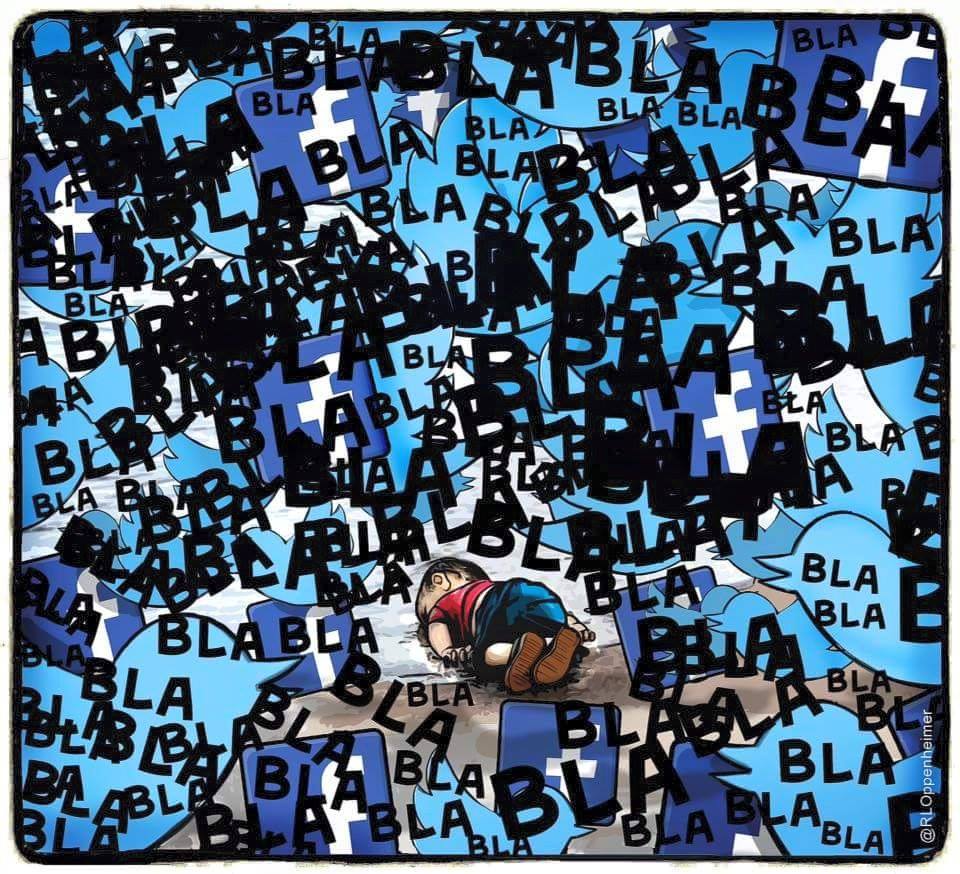
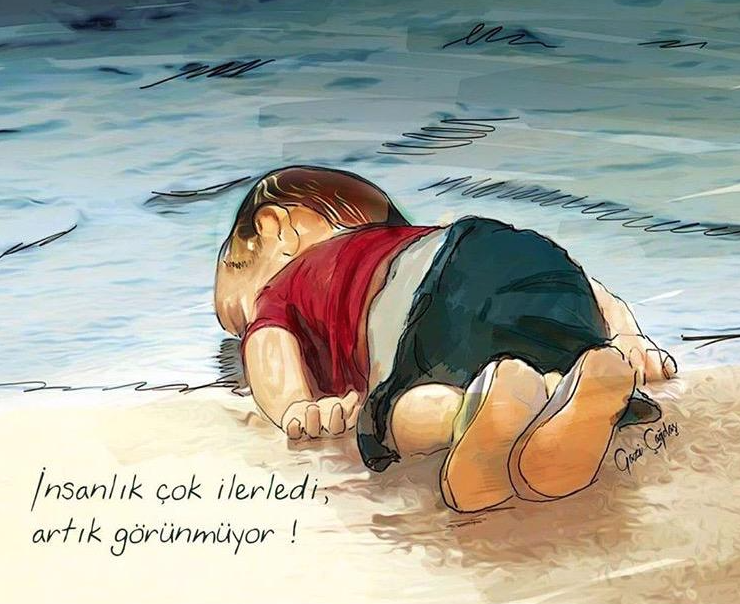
Not much more needs to be said about this photo because whatever can be said is utterly distressing. But the picture went viral in a global community, it instantly gave rise to memes and caricature replicas (see the image on top of this essay and the postscript below), it provoked hundreds of opinion and editorial articles in the mass media, and forced politicians to speak out. Even David Cameron, adamant until then about the UK’s refusal to accept more than a token number of new refugees, sounded mellow when he announced his willingness to accept a significantly higher number of refugees. The photo of Aylan (the boy’s name) had become a public opinion B-52..

***

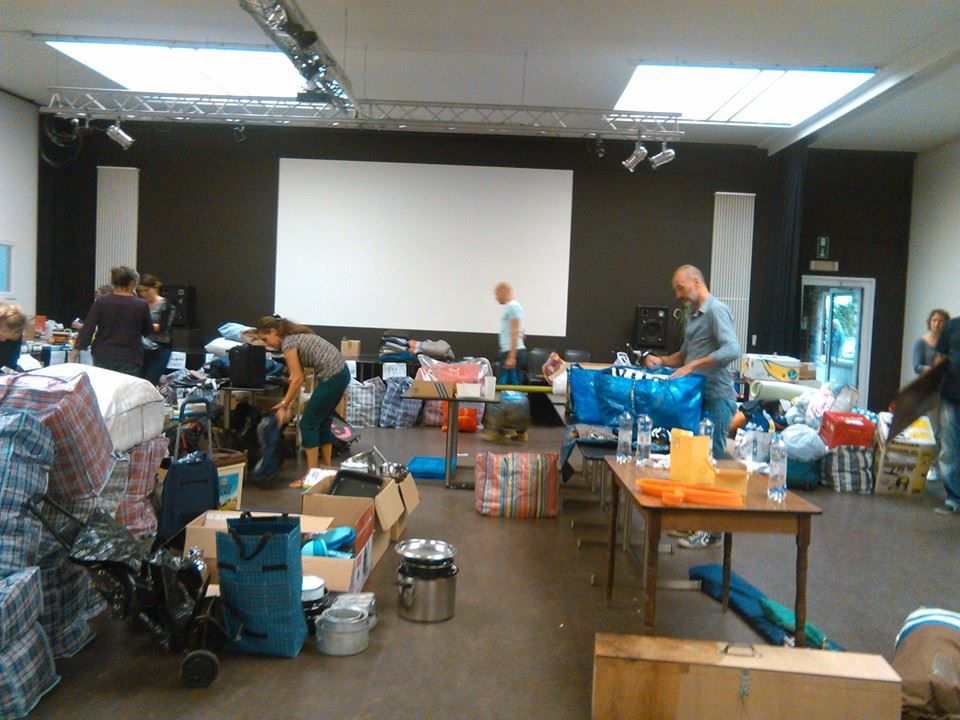
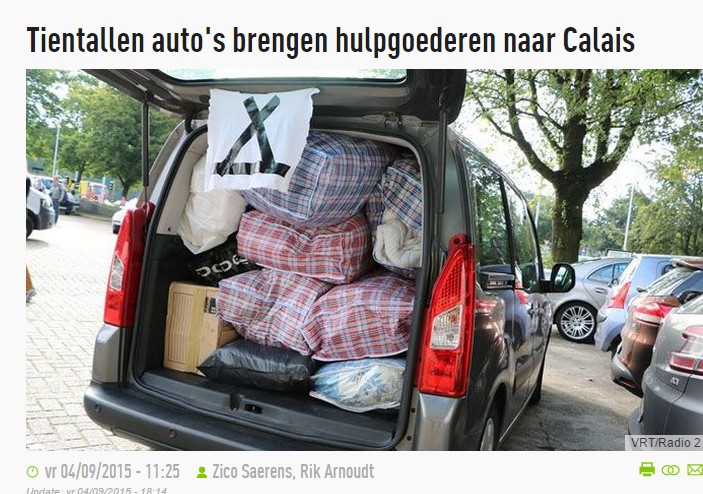
The publication of this third photo generated a mass of active solidarity across Europe; it is this photo that persuaded Bayern München to donate one million Euro for such purposes. In The Netherlands, over one hundred celebrities published an announcement in newspapers stating their willingness to personally host refugees, given their government’s extreme reluctance to take appropriate action in this direction. Similar actions were noted in France and Belgium. In Finland, the Prime Minister (not someone known for left-wing sympathies) announced that he would host asylum seekers in his private residence. In Belgium, an entirely spontaneous movement had formed, started by one individual on Facebook, collecting clothes, foods and other crucial items for the benefit of the thousands of refugees camping out in an informal settlement in Calais. In a couple of weeks, the movement grew spectacularly and acquired an amazing level of organization and effectiveness. The massive public impact of the third picture made today’s convoy of this movement to Calais suddenly headline news.

***

Three photos, thus, shifted the balance of public opinion on refugees in a matter of months. They became emblematic, not just as images of the crisis but also as pointers to the moral positions people can assume in relation to it. And morally, the debate is polarized: inactive or hesitant government personnel, PEGIDA and other racist actors are now the target of moral stigmatization, while support for and empathy with refugees is morally qualified as a self-evident instance of “good”. This moral polarization shows us, perhaps, one of the engines pushing the “light” communities of social media offline and into the realm of social and political action traditionally reserved for “thick” communities. Moral causes have become the fuel for a new type of formal-informal voluntarist politics.

There are historical precedents to this, of course. Many of us remember this picture of a girl dreadfully burned by a US napalm attack in Vietnam:

0

There, too, the focus of moral outrage was a child, terribly hurt by military actions officially targeting an “enemy”. And the picture had a seismic effect on US public opinion on the Vietnam War. This phenomenon was, however, quite exceptional. Given the tremendous affordances of the new media environment in which we now live, much more of this is to be expected. There is no predicting whether any instance of it (let alone which instances) will have the mobilizing effects of the three photos discussed here. But what may be predictable is that governments can, and will, be confronted with mass grassroots moral opposition whenever it happens; and that they have very little control over what will cause such trouble, and when.

They will leave such conflicts badly injured if they fail to appreciate that such forms of moral opposition have a more “absolute” character, and are therefore far more “popular”, more compelling and less liable to compromise, than the good old ideological conflicts and disagreements that structured the field of politics for so long. Some will call it populism, no doubt. But it is a grassroots populism – like it or not – that is rapidly changing the rules of politics.

11987139_10205128761393804_1916419204564628031_ntumblr_nay9g12H8V1ts25y7o1_12801377928936-preelection-welcome-refugees-rally-and-march-in-marrickville-sydney_2543104ScreenHunter_410 Sep. 04 18.27

POSTSCRIPT: “Aylan” as a viral motif

Within 24 hours after the publication of the third picture, the internet was ablaze with hundreds of popular-cultural uptakes of Aylan. Here is a small sample of them. See also

Artists Around The World Respond To Tragic Death Of 3-Year-Old Syrian Refugee

11960052_10153626030706248_6688090726283123667_n11953190_10206571607200138_6322936836348237348_n

1c127bde-5234-11e5-bc7f-594c1ef4cf26_original 606x340_312845 10136525-aylan-kurdi-dessins-et-photo-montages-pour-interpeller-les-politiques-sur-twitter 11855660_1179347732081755_1541023282886164069_n

Touchés par la photo d'Aylan Kurdi, ce petit garçon syrien de 3 ans gisant sans vie sur une plage turque après le naufrage de son embarcation, des dessinateurs ont pris leur crayon. Ici,
Touchés par la photo d’Aylan Kurdi, ce petit garçon syrien de 3 ans gisant sans vie sur une plage turque après le naufrage de son embarcation, des dessinateurs ont pris leur crayon. Ici, “L’Europe est morte”, pour Elchicotriste, auteur de ce dessin partagé sur https://twitter.com/elchicotriste0/status/639253610308726784

a-AYLAN-KURDI-DESSIN-640x468 aylan_syrien Aylan-image-720x547 Aylan-Kurdi-5 Aylan-Kurdi-6 aylan-kurdi-2015 aylan-kurdi-b media_xll_3266968 ScreenHunter_411 Sep. 04 19.13o-AYLAN-facebook VJUmAmel_AylanKurdi12063373_10208294853836113_4554920352813913736_n

by-nc

Chronotopic identities

download

Jan Blommaert 

In their seminal study on the unequally accessible cultural capital of French university students, Bourdieu and Passeron made the following remark:

“Sans doute, les étudiants vivent et entendent vivre dans un temps et un espace originaux” [“Undoubtedly, students live and expect to live in an original time and space”] (Bourdieu & Passeron 1964: 48)

The specific time they live in is measured by the academic year, with its semesters, lecturing times and exam sessions. And the way they live it is relaxed, slightly anarchic and down to themselves when it comes to organizing their days, weeks and months – “le temps flottant de la vie universitaire” [“the fluid time of university life”] (id: 51). The specific spaces include, of course, the university campus, its buildings, lecture halls and staff offices; but also “des quartiers, des cafés, des chambres ‘d’étudiants’” [“’student’ neighborhoods, cafés and rooms”], cinemas, dance halls, libraries, theaters and so forth; the Parisian Quartier Latin, of course, serves as a textbook example here (id.: 51). It is no miracle, then, that a walk through the Quartier Latin during the academic year would reveal a specific demographic pattern –a dense concentration of young people who would be students and middle-aged men who would be senior academics – different from, say, people shopping along the fashion stores on the Champs Elysées or taking the commuter trains out of Paris at 5PM.

According to Bourdieu and Passeron, due these specific timespace givens, students acquire a sense of shared experience which, invariably, becomes an important part of their autobiographies later in life – “in my student days”, “we met when we were students…” The specific timespace of student life involves specific activities, discourses and interaction patterns, role relationships and identity formation modes, particular ways of conduct and consumption, of taste development and so forth, most of which are new, demand procedures of discovery and learning, and involve the mobilization of existing cultural and social capital in the (differential) process of acquiring new capital. References to similar timespace elements (a charismatic or dramatically incompetent lecturer, a particular café or a then-popular movie or piece of music) create a shared sense of cohort belonging with others, which co-exists with pre-existing belongings to social groups and which enters into posterior forms of belonging. In that sense, our student days do not compensate for or replace pre-existing class memberships (which the book documents at length), and neither is it the sole bedrock for posterior identity formation – it is, in Bourdieu & Passeron’s view, a relatively superficial phenomenon, “[p]lus proche de l’agrégat sans consistence que du groupe professional” [“closer to an aggregate without consistency than to a professional group”] (56), let alone “un groupe social homogène, indépendant et intégré” [a homogenous, autonomous and integrated social group”] (49), which reproduces underlying (class) differences while constructing one new layer of shared biographical experience. Thus, while students share almost identical experiences and develop particular, and similar, identities during their days at the university, the meanings and effects of these shared experiences will differ according to the more fundamental social and cultural identity profiles they “brought along” to university life.

***

Probably without being aware of it, Bourdieu and Passeron provided us with one of the most precise empirical descriptions of what Bakhtin called a “chronotope” (Bakhtin 1981: 84-258). Bakhtin coined this term to point towards the inseparability of time and space in human social action and the effects of this inseparability on social action; in his work he identified the “literary artistic chronotope” where “spatial and temporal indicators are fused into one carefully thought-out, concrete whole”, such that the chronotope could be seen as “a formally constitutive category of literature” (1981: 84). By means of chronotopes Bakhtin could address the co-occurrence of events from different times and places in novels, the fact that shifts between chronotopes involved shifts of an entire range of features and generated specific effects. He saw the interplay of different chronotopes as an important aspect of the novel’s heteroglossia, part of the different “verbal-ideological belief systems” that were in dialogue in a novel, because every chronotope referred to socially shared, and differential, complexes of value attributed to specific forms of identity, as expressed (in a novel for example) in the description of the looks, behavior, actions and speech of certain characters, enacted in specific timespace frames. Bakhtin, importantly, assumed that chronotopes involve specific forms of agency, identity: specific patterns of social behavior “belong”, so to speak, to particular timespace configurations; and when they “fit” they respond to existing frames of recognizable identity, while when they don’t they are “out of place”, “out of order” or transgressive (see Blommaert 2015 for a discussion).

In a more contemporary and applied vocabulary, we would say that chronotopes invoke orders of indexicality valid in a specific timespace frame (cf. Blommaert 2005: 73). Specific timespace configurations enable, allow and sanction specific modes of behavior as positive, desired or compulsory (and disqualify deviations from that order in negative terms), and this happens through the deployment and appraisal of chronotopically relevant indexicals (i.e. indexicals that acquire a specific recognizable value in a specific timespace configuration). Thus, one can read Goffman’s Behavior in Public Spaces as a study of the orders of indexicality operating in public spaces and not elsewhere, while his description of poker players in Encounters can be read as a study of the orders of indexicality valid in places such as the poker rooms of Atlantic City or Las Vegas (Goffman 1963, 1961). Obviously, Howard Becker’s (1963) Outsiders also operate the way they do in clearly demarcated timespace configurations such as the nighttime jazz club, as much as studies of doctor-patient interaction typically are set in the timespace configuration of medical centers and consultation times therein (Cicourel 2002).

In such timespace configurations, Goffman situated specific actors enacting specific roles (poker players can never have met each other elsewhere, and they gather just to play poker and do that competently), enacting specific, relatively strict “rules of engagement” and normative assumptions (focus on the game, play the game by its rules), as well as identity judgments (a “superb” poker player). Goffman, like Bourdieu & Passeron, Becker and others, described the indexical organization of specific chronotopes: the ways in which specific socially ratified behavior depends on timespace configurations, or more broadly, the ways in which specific forms of identity enactment are conditioned by the timespace configurations in which they occur. The “gatherings” described in Behavior in Public Places are such timespace configurations, and the specific modes of behavior Goffman describes and analyzes are the ones that “fit” this specific configuration. The careful description of such nonrandom chronotopic connections, by the way, bears a well-known academic label: ethnography.[1]

***

This is the central idea that I wish to elaborate in what follows: we can see and describe much of what we observe as contemporary identity work as being chronotopically organized; it is organized in, or at least with reference to, specific timespace configurations which are nonrandom and compelling as “contexts”, and “chronotope” enables us to avoid an analytical separation of behavior and context which is not matched by the experiences of people engaged in such activities. In its most simple formulation, the idea I’m attempting to develop here is that the actual practices performed in our identity work often demand specific timespace conditions; a change in timespace arrangements triggers a complex and massive change in roles, discourses, modes of interaction, dress, codes of conduct and criteria for judgment of appropriate versus inappropriate behavior, and so forth.

Take a pretty simple example: a group of colleagues who share their 9-5 daytime in the same office; all of them have mutually known names and roles, often hierarchically layered, and specific shared codes of conduct govern their interactions (the shortcut term for such codes is often “professionalism”). Men are dressed in suits and neckties, ladies wear similar formal-professional dress. The group, however, has developed a weekly tradition of “happy hour”. Every Thursday after work, they jointly leave the office and walk to a nearby pub for a drink or two. The moment they leave their office building, men take off their neckties, and the tone, topics and genres of talk they engage in with each other change dramatically. “Professional” and job-focused talk may be exchanged for banter, small talk about family life, joke-cracking or flirting. And the roles and relationships change as well: the office “boss” may no longer be the “coolest” person, and a very competent worker may turn into a very incompetent drinker or joke-teller. We see the same people engaging in entirely different social practices and relationships, embodying entirely different roles and identities – due to a change in the timespace configuration in which they move. “Happy hour” behavior is intolerable during office hours, and office behavior is intolerable in the pub (“no job talk!!”) – timespace reordering involves a complete reordering of the normative codes of conduct.

after work drink HK

Such phenomena, once we start looking for them, occur constantly. In fact, one may be hard pressed to come up with modes of social conduct that are not conditioned by nonrandom timespace arrangements. My suggestion here is to take this kind of “context” seriously – that is, let us address it in a systematic and meticulous way and see what purchase it has. Doing so may increase the accuracy of our analyses of the dynamic and changing nature of social life and of the groups that organize it. And as to these groups, identifying chronotopically organized identity work might contribute to a clearer understanding of the “light” communities we witness in so much contemporary work (see Blommaert & Varis 2015). Let me now try to outline some aspects of this issue.

***

At the most basic level, it is good to point out that the chronotopic nature of specific forms of identity is already entrenched in our everyday vocabularies. Thus, when we speak of “youth culture”, we obviously speak (be it with perplexing vagueness even in published work) about a complex of recognizable cultural phenomena attributed to a specific period in human lives – “youth” – which is often also specific to a place or a region. Talcott Parsons’ (1964: 155-182) discussion of American youth culture, thus, differs from that of French youth offered at the same time by Bourdieu and Passeron. “Youth culture”, therefore, is always a chronotopically conditioned object of study.

Let us take this commonsense observation as our point of departure. Identifying something as “youth culture” in terms of its chronotopic conditions involves and explains certain things. I shall first look at what it involves.

It involves generalizability. If specific forms of cultural practice mark specific periods of life, all such periods must have their own forms of cultural practices. In other words, a chronotopic qualification such as “youth culture” could (and perhaps must) be extended to any other form of cultural practices describable as tied to and conditioned by specific timespace configurations. In fact, there is nothing more special to “youth culture” than to, say, the culture of young parents, mature professionals or retired senior citizens. In each case we shall see specific forms of practice and identity construction conditioned by the specific stage of life of the ones who enact them, and usually also involving trajectories through specific places (think of schools for teenagers, banks for young people taking their first mortgage, kindergarten for young parents). And just as youth cultures typically set themselves apart by specific forms of jargon and slang (now both in spoken and written forms), other age groups similarly display such discursive and sociolinguistic characteristics.

Generalizability, in turn, implies fractality. There is no reason why chronotopic cultural practices would be confined to the “big” stages of life only, because even within narrower timespans we can see nonrandom co-occurrences of timespace configurations and forms of cultural practice and identity enactment. Think of the timeframe of a week, for instance, in which specific days would be reserved for “work” (involving specific trajectories through time and space) and others for, say, religious services, family meetings, shopping and leisure activities. The timeframe of a single day in such a week, in turn, can be broken down into smaller chronotopic units, with activities such as “breakfast”, “dropping kids off at school”, “going to work”, “being at work”, “returning from work” and eventually “watching TV in bed” all marked by nonrandom collocations of time, space and behavioral modes. The rules of macroscopic conduct also apply to microscopic behavior.

And if we take this second implication through to analytical strategy, we can see that in actual analysis, different chronotopes interact. The macroscopic chronotopes intersect and co-occur together with the microscopic ones, and the different chronotopes need to be constantly balanced against each other. To be more precise, the chronotope of youth culture, when looked at in practice, is composed of a large quantity of more specific chronotopic arrangements. Students, for instance, can perform much of their student practices from Monday till Friday in a university town, but perform their practices of friendship, family life, love relationships, entertainment and local community involvement during the weekend in their home town. And this is dynamic as well: the freshman student will organize his/her life differently from the senior and more experienced student, just as the junior professional will act differently from the “old hands” (and note that the transition from newcomer to old hand can happen very quickly – the literature on the experiences of frontline soldiers in the Great War is replete with stories of “aging” overnight during their first battle).

Different chronotopes interact also in ways that may shed light on contemporary forms of cultural globalization in which local and global resources are blended in complex packages of indexically super-rich stuff. Hip Hop is a prime example, of course (Pennycook 2007, Westinen 2014), where the global AAVE templates of Hip Hop are blended with deep sociolinguistic locality – often strictly local dialects – and lyrics that bespeak the (chronotopic) condition of local youth-in-the-margins. Chronotopes, thus, also involve scalar distinctions, and such scalar distinctions can be seen as the features that enable relatively unproblematic co-occurrences rather than conflictual ones.

***

The chronotopic nature of cultural practices explains a number of things as well. It explains generations, anachronisms and obsolete cultural practices, for instance.

Except for census sociology, generations are notoriously fuzzy and puzzling units of sociocultural analysis. As Bourdieu and Passeron pointed out, the joint experience, several years long, of being a student in the same university and program does not cancel the power of reproduction of inequalities across “generations”. Thus upper-class and working-class people may have attended the same schools, the same lectures and movie or theater performances, and spent time in the same cafés and neighborhoods – none of that would reshuffle the transgenerational cards of social class difference, for the same experiences have different meanings and effects depending on this slower process of transmission and social dynamics. The “generation” of social class, therefore, is a slower and longer one than that of, say, “intellectuals”, “engineers” or “jazz lovers”.

I would suggest that we can get a more precise grip on “generations” when we consider what was said above: that at any point in time, we organize our lives within interacting macroscopic and microscopic chronotopes. This means that at any point, our cultural repertoires might contain obsolete elements that no longer “fit” into the social order we now incorporate. Middle-aged people typically still have (and upon request, can perform) a vocabulary of slang obscenities developed during adolescence and hugely functional at that stage of life as symbolic capital for “cool” or “streetwise” peer group identities, but for the deployment of which very little occasion can be found in life at present. Similarly, many people still know small bits of mathematics jargon, of Latin and Ancient Greek, learned in high school but never used again since the last day of school. Such resources remain in the repertoire and can, perhaps, be invoked on nostalgic storytelling occasions, but would have very little other function or value. As we move through “generations”, the cultural stuff that defined the chronotopic arrangements of earlier stages remains in our repertoire, but becomes obsolete.

Such forms of obsoleteness, I would propose, might be of interest if we wish to get a precise understanding of sociocultural change. Entirely new phenomena are often tackled by means of very old and obsolete cultural resources – they are often tackled by means of anachronisms, in other words. Thus, the key social identifier on Facebook – something entirely new, see further – is “friends” – one of the oldest notions in the vocabulary of social relations anywhere. The entirely new social community configuration of Facebook “friends” is thus anachronistically addressed and molded in the terms of an entirely different social community configuration. The example can be infinitely multiplied: new events, processes and phenomena can be normal for a younger generation and simultaneously abnormal for an older one, while it is the older one that holds, in many social domains, the power to define, regulate and judge these new things, and will typically do this by taking refuge in old, obsolete concepts or discourses. Such anachronisms are often the stuff of public debate and social conflict, as when the “Baby Boomers” are blamed for the creation of economic bubbles and overspending, the “Woodstock generation” is getting crucified for their tolerance of soft drugs, or the soixante-huitards (those who were students in May 1968) are coming under attack for a lofty leftism or the “decay” of the moral order.

It is this layered (heteroglossic) co-presence of chronotopically organized practices, in a sometimes unbalanced and anachronistic way, that may lead us towards the finer grain of social order and social conflict. What exactly is contested across generations? And how exactly does this contestation operate? Those are questions we might begin to explore now.

***

Similarly, an awareness of the layered co-presence of such practices may enable us to get a more precise understanding of the complex balance between “thick” and “light” communities and forms of membership therein. In earlier work, we pointed towards the – in our view growing – importance of “light” communities on social media (Blommaert & Varis 2015), where people gather and jointly act while focusing on lifestyle objects, meanings and practices. Such “light” groups were never really privileged by sociology: the Durkheimian and Parsonian tradition had a marked preference, precisely, for the mechanisms of cohesion and integration that brought multiple disparate “light” communities together into a “thick” community (the nation, the tribe, the region, the family, the religious community etc.). And we have seen above how Bourdieu and Passeron disqualified students as an “aggregate without consistency” which could surely not qualify as a “real” social group.

Bourdieu and Passeron argued that in decent sociological study of students, due to the ephemeral character of this community, should not address the student community in isolation, for it could never be seen as entirely autonomous with respect to the larger, deeper forces of social class distinction (Bourdieu & Passeron 1964: 56). Thus, while students could be studied as a group, they could not be studied as a group in itself; the “groupness” of students must, rather, be constantly checked as to its features and characteristics against the “thick” community structures upon which it was grafted. I suggest that we can considerably refine Bourdieu and Passeron’s relatively rough base-superstructure model by paying attention to the specific chronotopic organization of behavior judged to be characteristic of specific groups. It would enable us, perhaps, to see that the “thick” structures, while perhaps determining, are not necessarily dominant in explaining the social valuation of cultural practices typical of “light” communities – the precise mode of valuation will be an effect of the specific chronotopic arrangements we address.

***

The largest social space on earth these days is the virtual space. And it is entirely new as a sociological and anthropological fact. I already mentioned how entirely new social environments such as social media are often approached from within anachronistic modes of social imagination; and the world of social analysis does not differ too much from that of lay practices in this respect.

I can only point towards the possibility of an extraordinarily interesting line of research in the vein sketched here. There are specific timespace challenges raised by online culture: contrary to the social imagination of classical sociology and anthropology, the social practices developed online involve no physical copresence but a copresence in a shared “virtual” space of unknown scale-dimensions, involve often an unknown number of participants (also often of unknown identity), combined with a stretchable timeframe in which temporal copresence is not absent but complemented by an almost unlimited archivability of online communicative material.

Thus, determining the specific chronotopic nature of cultural practices in a virtual cultural sphere promises to be a stimulating and thought-provoking exercise. Issues of scale – the internet is an immense social space – will call for ethnographic precision in analysis, so as to avoid rapid but unfounded generalizations of the kind “Facebook is a family of 2 billion people”. Using a far more refined research tool, directed with great precision at the specific context-situatedness of any form of social practice, must help us ditch such sociological (as well as political) illusions and replace them with a more complex, but also far more accurate, image of what really goes on in that colossal social space, what exactly contributes to modes of social organization there, and how patterns of organization change over time.

References

Bakhtin, M.M. (1981) The Dialogic Imagination (ed. M. Holquist). Austin: University of Texas Press

Becker, H. (1963) Outsiders: Studies in the sociology of deviance. Glencoe: Free Press

Blommaert, J. (2005) Discourse: A critical introduction. Cambridge: Cambridge University Press.

Blommaert, J. (2015) Chronotopes, scale and complexity in the study of language in society. Annual Review of Anthropology 44 (in press).

Blommaert, J. & P. Varis (2015) Enoughness, accent and light communities: Essays on contemporary identities. Tilburg Papers in Culture Studies paper 139. https://www.tilburguniversity.edu/upload/5c7b6e63-e661-4147-a1e9-ca881ca41664_TPCS_139_Blommaert-Varis.pdf

Bourdieu, P. & J-C. Passeron (1964 [1985]) Les Héritiers: Les Etudiants et la Culture. Paris: Minuit.

Cicourel, A. (2002) Le Raisonnement Médical (eds. P. Bourdieu & Y. Winkin). Paris: Seuil.

Durkheim, E. (1985 [2010]) Les Règles de la Méthode Sociologique. Paris: Flammarion.

Goffman, E. (1961) Encounters: Two studies in the sociology of interaction. Indianapolis: Bobbs-Merrill

Goffman, E. (1963) Behavior in Public Places: Notes on the organization of gatherings. New York: Free Press.

Lukes, S. (1973) Emile Durkheim: His life and Work – A historical and critical study. Harmondsworth: Penguin

Parsons, T. (1964 [1970]) Social Structure and Personality. New York: Free Press.

Pennycook, A. (2007) Global Englishes and Transcultural Flows. London: Routledge

Westinen, E. (2014) The Discursive Construction of Authenticity: Resources, scales and polycentricity in Finnish Hip Hop culture. PhD Dissertation, Tilburg University & University of Jyväskylä.

[1] Or ethnomethodology and related disciplinary labels. In a similar vein, one can see the structuralist attempts at generalization and universalization as dechronotopicalizing attempts trying to transcend the levels of chronotopic situatedness inherent in all social behavior. Durkheim’s definition of “social fact” is an obvious and extremely influential case in point (Durkheim 1895: 99-113; see also Lukes 1973: 8-15). Saussure’s concept of “Langue” is a domain-specific application of Durkheim’s “social fact”.